Quick Summary
Crypto cashback is safe when it comes from a legitimate platform that uses official exchange referral partnerships. It is not a Ponzi scheme, not a hidden fee, and not a trap — it's a standard referral commission that exchanges pay from their marketing budget to attract new traders. Platforms like cashback.day pass the majority of that commission back to you as daily USDT payments. The real risks are not from the cashback mechanism itself, but from choosing unverified platforms, exchange failures, and your own trading decisions.
Key facts:
- ✅ Your trading fees are identical to any other user — cashback doesn't increase your costs
- ✅ Funds never leave your exchange account — cashback platforms don't have access to your assets
- ✅ The money comes from exchange marketing budgets, not other users' funds
- ✅ Major exchanges officially support and endorse referral/cashback programs
- ❌ Cashback does NOT protect against trading losses — you can still lose money trading
How Crypto Cashback Actually Works
Understanding the mechanics is the key to understanding why cashback is safe. Here's the complete flow, step by step:
The Business Model Explained
You → Sign up through cashback.day → Trade on exchange
                                          ↓
Exchange charges you standard trading fees (same as everyone)
                                          ↓
Exchange pays cashback.day a referral commission (from marketing budget)
                                          ↓
cashback.day keeps a small portion → Sends majority to you as USDT
Why Exchanges Pay Referral Commissions
Exchanges spend hundreds of millions of dollars annually on marketing. Here's what user acquisition costs look like:
| Marketing Channel | Cost Per Acquired Trader | Lifetime Value |
|---|---|---|
| :--: | :: | :--: |
| Google Ads | $50 - $200 | $500+ |
| Social media ads | $30 - $150 | $500+ |
| Influencer sponsorship | $20 - $100 | $500+ |
| Referral/Cashback | $10 - $50 | $500+ |
| TV/Billboard ads | $100+ (indirect) | Unknown |
Referral programs are the most cost-effective way for exchanges to acquire active traders. Rather than paying Google or Meta for clicks that may not convert, they pay a commission only after a real trader is actively generating fees. This is why exchanges willingly share 20-50% of trading fees as referral commissions.
Where the Money Comes From
This is the most important question, and the answer eliminates the "too good to be true" concern:
| Source | What Happens | Your Impact |
|---|---|---|
| -- | - | |
| Exchange marketing budget | Exchanges allocate % of revenue to user acquisition | Zero — you're not paying more |
| Not from other users | Unlike Ponzi schemes, no user funds are redistributed | No dependency on new users |
| Not from your deposit | Your principal and profits are untouched | Your balance only grows from cashback |
| Standard business practice | Used by Amazon, credit cards, airlines for decades | Proven, sustainable model |
The Amazon Analogy
Think of crypto cashback like Amazon Associates or credit card cashback:
- Amazon pays 1-10% commission to affiliates who refer buyers
- Credit cards give 1-5% cashback from merchant fees
- Crypto exchanges pay 20-50% of trading fees as referral commissions
All three work the same way: a business shares part of its revenue with partners who bring customers. There's no magic, no hidden cost, no pyramid structure.
Why It Sounds Too Good to Be True
Let's address the skepticism directly. "Getting money back for doing what you'd normally do" triggers several cognitive biases:
Cognitive Bias #1: "Free Money Doesn't Exist"
Reality: It's not free money. The exchange is paying you to be their customer instead of paying Google to advertise to you. The "free money" is redirected marketing spend.
Cognitive Bias #2: "High Percentage = Scam"
Reality: 20-30% sounds high compared to credit card cashback (1-5%), but crypto trading fees are much higher per transaction. A 0.10% trading fee on $10,000 = $10. The exchange sharing $2-3 of that $10 as cashback is completely reasonable when their alternative is spending $50-200 on ads to acquire that same trader.
Cognitive Bias #3: "If It Benefits Everyone, Something's Wrong"
Reality: Win-win-win structures exist throughout business. The exchange wins (they acquired an active trader cheaply), the cashback platform wins (they earn a small commission share), and you win (you get money back). All three benefit because the exchange would otherwise waste that money on less effective marketing.
Cognitive Bias #4: "It Must Be Temporary"
Reality: Exchanges have operated referral programs since their founding. Binance launched its referral program in 2017, and it's still running in 2026 — nine years later. Referral commissions are a permanent, structural part of exchange economics, not a promotional gimmick.
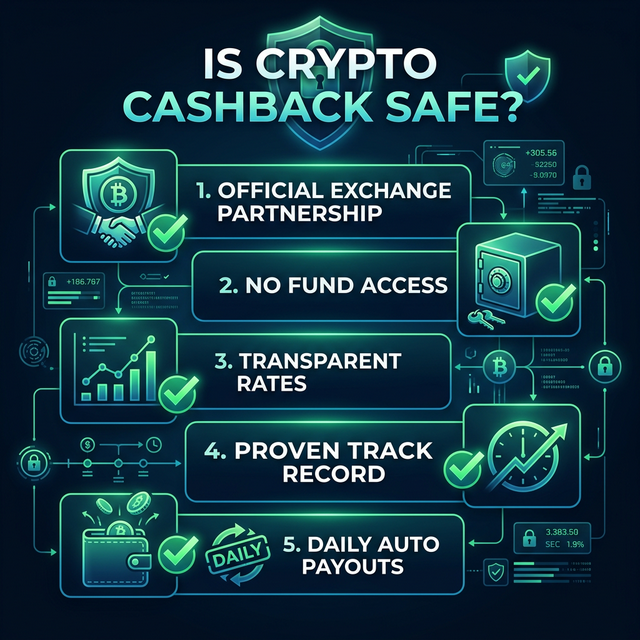
The 5-Point Safety Checklist
Before using any crypto cashback program, verify these five criteria:
✅ 1. Official Exchange Partnership
How to verify: Check if the cashback platform uses official referral links that redirect to the exchange's registration page. Look for the referral code in the URL parameters.
cashback.day status: Official partner of Binance, Bybit, OKX, MEXC, Bitget, and BingX. All links redirect directly to official exchange registration.
✅ 2. No Access to Your Funds
How to verify: A legitimate cashback platform should NEVER ask for your exchange password, API keys with withdrawal permission, or private wallet keys.
cashback.day status: Zero access to your exchange account. The only connection is through a referral code applied at registration. cashback.day cannot view, move, or withdraw your funds.
✅ 3. Transparent Rate Structure
How to verify: Published cashback rates should match what you actually receive. Calculate manually: (trading fee × cashback %) should equal the USDT you receive.
cashback.day status: Published rates verified through real trading data. 20% Binance, 25% OKX, 25% BingX, 30% Bybit, 30% Bitget, 32.5% MEXC.
✅ 4. Proven Track Record
How to verify: Look for platform age, user reviews, social media presence, and payout history. Be skeptical of platforms with no history.
cashback.day status: Operating since launch with consistent daily payouts. Active social media presence and verified user testimonials.
✅ 5. Daily Automated Payouts
How to verify: Legitimate platforms pay cashback automatically and frequently (daily is standard). Manual claiming or long payout delays are warning signs.
cashback.day status: Fully automated daily payouts in USDT directly to your exchange account. No manual claiming, no minimum thresholds.
Real Risks You Should Know About
While cashback itself is safe, there are legitimate risks in the broader context that you should understand:
Risk 1: Exchange Risk (Not Cashback Risk)
If an exchange goes bankrupt (like FTX in 2022), you could lose funds held on that exchange. Mitigation: Use reputable exchanges with proof of reserves, and don't store more on any exchange than you need for active trading.
Risk 2: Trading Risk (Not Cashback Risk)
Cashback reduces fees but doesn't protect against trading losses. A 20% cashback on fees doesn't help if your trade loses 20% of its value. Mitigation: Practice sound risk management — stop losses, position sizing, and diversification.
Risk 3: Regulatory Risk
Crypto regulations vary by country and can change. Some jurisdictions may restrict or ban certain exchanges. Mitigation: Understand your local regulations, use compliant exchanges, and keep records of cashback payments for tax purposes.
Risk 4: Tax Implications
In most jurisdictions, cashback is considered taxable income. Treat cashback USDT as income and report it accordingly. Mitigation: Keep records of all cashback payments. cashback.day provides a complete history on your dashboard.
Risk 5: Fake Cashback Platforms
Scam platforms may promise cashback but steal your data or redirect you to fake exchange sites. Mitigation: Only use verified, established cashback platforms with official exchange partnerships.
| Risk | Source | Severity | Mitigation |
|---|---|---|---|
| -- | :--: | -- | |
| Exchange failure | Exchange | High | Use reputable exchanges, proof of reserves |
| Trading losses | Your decisions | High | Risk management, stop losses |
| Regulatory changes | Government | Medium | Stay informed, use compliant platforms |
| Tax reporting | Legal obligations | Low | Keep records, consult tax advisor |
| Fake platforms | Scammers | Medium | Verify official partnerships |
Common Scam Patterns to Avoid
🚩 Pattern 1: Unrealistically High Rates
Red flag: "50% cashback!" or "100% fee refund!"
Why it's suspicious: Exchanges typically share 30-50% of fees with partners. A platform promising 50%+ cashback either has unsustainable economics or is outright lying.
Safe range: 20-35% cashback is realistic and sustainable.
🚩 Pattern 2: Deposit Requirements
Red flag: "Deposit $500 to activate your cashback!"
Why it's suspicious: Real cashback requires zero deposit. The referral code activates automatically when you register.
Reality: cashback.day requires $0 deposit. Cashback starts from your first trade.
🚩 Pattern 3: Asking for Private Keys
Red flag: "Enter your wallet private key for cashback redemption"
Why it's suspicious: NO legitimate platform EVER needs your private keys.
Reality: Run. This is a theft attempt.
🚩 Pattern 4: Manual Claiming with Fees
Red flag: "Pay $20 gas fee to claim your $50 cashback"
Why it's suspicious: This is the classic "advance fee" scam. There's no cashback waiting.
Reality: Legitimate cashback is deposited automatically — no claiming needed.
🚩 Pattern 5: Fake Exchange Websites
Red flag: URL that looks like binance but has subtle misspellings (blnance.com, b1nance.com)
Why it's suspicious: Phishing sites designed to steal your credentials.
Reality: Always verify you're on the official exchange domain after clicking any link.
🚩 Pattern 6: Telegram/WhatsApp "Guaranteed Returns"
Red flag: "Join our VIP group for guaranteed 5% daily returns + cashback"
Why it's suspicious: Combining cashback with guaranteed returns signals a Ponzi scheme.
Reality: Cashback only reduces trading fees. No one can guarantee trading profits.
How cashback.day Ensures Safety
Security Architecture
| Safety Measure | Implementation |
|---|---|
| :-: | : |
| No fund access | Platform never touches your exchange balance |
| Official partnerships | Verified partner with all listed exchanges |
| Automated payouts | Daily USDT deposits, no manual intervention |
| Transparent tracking | Real-time dashboard showing all trades and cashback |
| No personal data | Minimal data collection — only referral tracking |
| No withdrawal keys | Zero API access to your exchange account |
What cashback.day CAN Do
- Track which trades you made through the referral link
- Calculate your cashback based on trading fees
- Send USDT to your exchange account daily
- Provide a dashboard showing your history
What cashback.day CANNOT Do
- View your exchange balance
- Execute trades on your behalf
- Withdraw any funds from your account
- Access your personal exchange settings
- See your trading strategy or positions
How the Daily Payout Process Works
You trade on the exchange throughout the day
The exchange calculates referral commissions for your referee (cashback.day)
The exchange transfers commission to cashback.day
- cashback.day calculates your share (published %)
USDT is deposited to your exchange account
You can see the deposit in your transaction history and on the cashback.day dashboard
Cashback vs Other "Crypto Money-Making" Schemes
| Feature | Crypto Cashback | Ponzi Scheme | Yield Farming | Pyramid/MLM |
|---|---|---|---|---|
| :--: | :: | :-: | :--: | |
| Source of money | Exchange marketing | New investors | Protocol rewards | Recruits |
| Sustainable? | ✅ Indefinitely | ❌ Collapses | ⚠️ Variable | ❌ Collapses |
| Requires recruitment? | ❌ No | ✅ Yes | ❌ No | ✅ Yes |
| Risk of loss? | ❌ None from CB | ✅ High | ⚠️ Smart contract risk | ✅ High |
| Regulated? | ✅ Part of exchange | ❌ Illegal | ⚠️ Varies | ❌ Often illegal |
| Track record | 9+ years | Months | Varies | Months |
Step-by-Step: How to Start Safely
Step 1: Choose a Verified Platform
Use cashback.day — verified partnerships with all major exchanges, transparent rates, daily automated payouts.
Step 2: Pick Your Exchange
Visit cashback.day/compare to compare exchanges and cashback rates. Choose based on your trading needs.
Step 3: Register Through the Official Link
Click the exchange link on cashback.day. Verify you land on the official exchange website (check the URL domain).
Step 4: Complete Exchange Verification
Follow the exchange's standard KYC process. This has nothing to do with cashback — it's a normal exchange requirement.
Step 5: Start Trading
Trade normally. No special actions needed for cashback — it applies automatically to every qualifying trade.
Step 6: Verify Your First Cashback
After your first trading day, check your USDT balance for the cashback deposit. You can also verify on the cashback.day dashboard.
Step 7: Monitor Regular Payouts
Check your dashboard periodically to confirm consistent payouts and verify the math matches published rates.
Frequently Asked Questions
Can cashback.day steal my funds?
No. cashback.day has zero access to your exchange account. The platform only tracks referral activity through the exchange's official partner API. Your funds, passwords, and private keys are never shared.
Why do some people say crypto cashback is a scam?
Confusion with actual scams that misuse the word "cashback" as a lure. Real crypto cashback through official exchange partners is a legitimate referral commission sharing model used by every major exchange.
Do I pay higher fees if I sign up through a cashback link?
No. Your fees are identical to any other user at the same VIP level. The exchange pays the referral commission from its marketing budget, not by charging you more.
What happens if cashback.day goes offline?
Your exchange account and trading continue normally. You'd simply stop receiving cashback until/if you switched to another referral partner. Your funds are never at risk.
Is crypto cashback taxable?
In most jurisdictions, yes. Cashback received as USDT is typically considered income. Consult a tax professional for your specific situation and keep records of all payments.
Can I trust exchanges that offer cashback?
The exchanges themselves are independent entities. Cashback doesn't affect exchange trustworthiness. Evaluate exchanges on their own merits: regulation, proof of reserves, security track record.
How do I verify I'm receiving the correct cashback amount?
Check your daily USDT deposits against your trading volume and the published cashback rate. For example: $10,000 trade × 0.10% fee = $10 fee × 20% cashback = $2 expected. cashback.day's dashboard shows detailed per-trade calculations.
Expert Opinions on Crypto Cashback Safety
Industry Analysis
The crypto cashback model is fundamentally identical to traditional affiliate marketing, which has been a standard business practice for over 20 years. Key industry perspectives:
From exchanges: Binance, Bybit, OKX, and other major exchanges actively promote their referral programs. These aren't hidden features — they're prominently displayed on exchange websites, often with dedicated referral program pages explaining the mechanics.
From regulators: In most jurisdictions, crypto referral commissions are treated as standard business income, similar to affiliate marketing income. There's no special regulatory concern about the cashback mechanism itself — only about the underlying crypto trading activity.
From financial educators: Well-known crypto educators openly discuss cashback programs as one of the legitimate ways to reduce trading costs. The consensus is clear: if the cashback comes from a reputable exchange's official referral program, it's a straightforward marketing cost-sharing arrangement.
How Long Has This Model Existed?
| Exchange | Referral Program Launch | Years Active |
|---|---|---|
| :--: | :-: | :: |
| Binance | 2017 | 9 years |
| Bybit | 2018 | 8 years |
| OKX | 2017 | 9 years |
| MEXC | 2018 | 8 years |
| Bitget | 2020 | 6 years |
| BingX | 2021 | 5 years |
Every major exchange has maintained its referral program for years — proof that the model is sustainable and profitable for all parties.
Protecting Yourself: A Complete Safety Guide
Before You Start
Research the cashback platform — look for verified partnerships, user reviews, social proof
Verify exchange links — always check URLs land on official exchange domains
Never share private keys — no legitimate platform needs them
Understand the model — if you can't explain where the cashback money comes from, do more research
While Using Cashback
Monitor payouts — verify daily USDT deposits match expected amounts
Keep records — screenshot or export your cashback history for tax purposes
Don't overtrade — cashback is a passive bonus, not a reason to increase trading frequency
Diversify exchanges — don't put all funds on one exchange, even with cashback
Red Flags to Watch For
- Platform suddenly changes terms or reduces rates without notice
- Delayed payouts beyond the stated schedule
- Customer support becomes unresponsive
- Platform asks for additional personal information beyond what's needed
The Bottom Line
Crypto cashback through legitimate platforms like cashback.day is safe, sustainable, and simple. The money comes from exchange marketing budgets — a proven business model used by credit cards, airlines, and e-commerce for decades.
The only real decision is whether to leave money on the table or not.
Every trade you make without cashback is a trade where you pay full fees unnecessarily. Setting up cashback takes 2 minutes and provides savings for life.
Start safely today: cashback.day
Compare exchanges: cashback.day/compare
Calculate savings: cashback.day/calculator
Sources: Exchange referral program documentation (Binance, Bybit, OKX, MEXC, Bitget, BingX). FTX bankruptcy cited from public court filings. Marketing cost estimates from industry reports. All cashback rates verified through cashback.day (March 2026).
Final Thoughts: Building Long-Term Trust
The crypto cashback landscape has matured significantly since its early days. What was once an unfamiliar concept is now an established mechanism used by millions of traders worldwide. The key to staying safe is understanding how the system works and choosing trusted platforms with verifiable track records.
As the cryptocurrency industry continues to evolve, cashback programs will become increasingly standardized and regulated. By following the guidelines in this article, you can confidently participate in cashback programs knowing that your funds and personal data remain protected while you save money on every trade.