Quick Answer: Maker Orders Get Lower Fees and Maximize Your 20% Cashback
The difference between maker and taker fees is one of the most impactful factors in crypto trading profitability, yet most traders never think about it. In simple terms: when you place a limit order that adds liquidity to the order book, you pay the maker fee. When you place a market order that removes liquidity, you pay the higher taker fee. This difference can range from 0% to 0.10% per trade, and when compounded over hundreds of trades per month, it creates a massive gap in total fees paid.
Here is the critical insight for cashback optimization: your 20% cashback through cashback.day is calculated as a percentage of your trading fees. Lower maker fees mean a lower cashback amount per trade, but consistently using maker orders reduces your overall trading costs so dramatically that the net savings far exceed what you would get from taker-only trading with higher cashback amounts. However, the optimal strategy is more nuanced than simply choosing one or the other.
This comprehensive guide breaks down exactly how maker and taker fees work on every major exchange, how cashback applies to each fee type, and the specific strategies that professional traders use to minimize their total trading costs while maximizing cashback returns.
What Are Maker and Taker Fees? The Order Book Mechanics
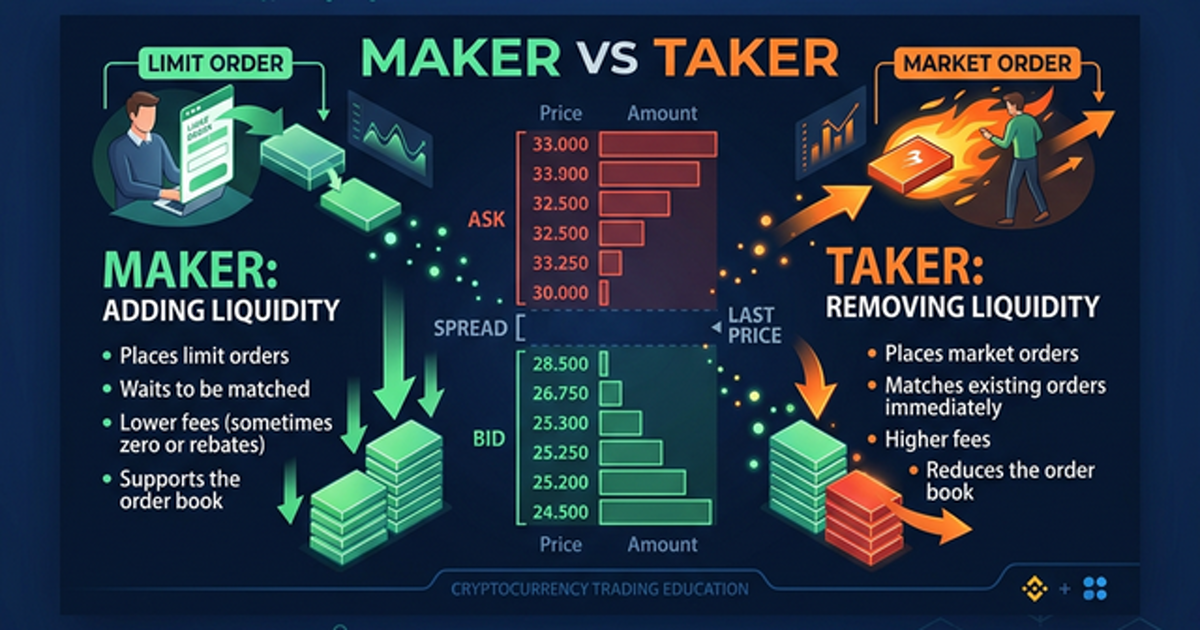
Every centralized cryptocurrency exchange operates an order book system that matches buyers with sellers. When you place a trade, the exchange needs to determine whether your order adds liquidity to the order book or removes it. This classification determines which fee you pay.
Maker Orders: Adding Liquidity to the Market
A maker order is any order that does not execute immediately but instead sits on the order book waiting to be filled. The most common type is a limit order placed away from the current market price. For example, if Bitcoin is trading at $60,000 and you place a buy limit order at $59,500, your order goes onto the order book and waits. You are making liquidity available for other traders to take.
Maker orders are rewarded with lower fees because they serve a crucial purpose: they provide depth to the order book. A deep order book with lots of limit orders at various price levels creates a healthy, liquid market where large trades can execute without significant price impact. Exchanges want to incentivize this behavior, so they charge makers less.
Typical maker fee ranges across major exchanges:
- Spot trading: 0.000% to 0.100%
- Futures trading: 0.000% to 0.020%
Some exchanges, including MEXC, offer zero maker fees on both spot and futures markets, meaning you can trade completely free when using limit orders.
Taker Orders: Removing Liquidity from the Market
A taker order executes immediately against existing orders on the book. Market orders are the most obvious example, as they fill instantly at the best available price. However, limit orders can also be taker orders if they are placed at or better than the current market price and execute immediately.
For example, if Bitcoin is at $60,000 and you place a buy limit order at $60,100, your order will execute immediately against sell orders on the book because your price exceeds the current ask. Despite being a limit order, this is treated as a taker order because it removes liquidity.
Taker orders carry higher fees because they consume the liquidity provided by makers. Without takers, makers would never get their orders filled, so the system requires both. Exchanges charge takers more as compensation for the liquidity they consume.
Typical taker fee ranges:
- Spot trading: 0.050% to 0.100%
- Futures trading: 0.010% to 0.060%
The Critical Distinction: It Is Not About Order Type, It Is About Execution
A common misconception is that limit orders always pay maker fees and market orders always pay taker fees. This is not entirely accurate. What determines the fee is whether your order adds or removes liquidity at the moment of execution:
| Scenario | Order Type | Fee Type | Reason |
|---|---|---|---|
| Limit buy at $59,500 when BTC is $60,000 | Limit | Maker | Order sits on book, adds liquidity |
| Limit buy at $60,100 when BTC is $60,000 | Limit | Taker | Order fills immediately, removes liquidity |
| Market buy when BTC is $60,000 | Market | Taker | Always fills immediately |
| Stop-limit that triggers at market price | Stop-limit | Taker | Executes immediately when triggered |
| Post-only limit order | Limit | Maker (guaranteed) | Exchange rejects if it would be a taker |
The post-only order type is particularly important for cashback optimization. Available on most major exchanges, post-only orders are guaranteed to be maker orders. If a post-only order would execute immediately (which would make it a taker), the exchange cancels it instead of filling it. This ensures you always pay the lower maker fee.
Maker vs Taker Fees on Every Major Exchange
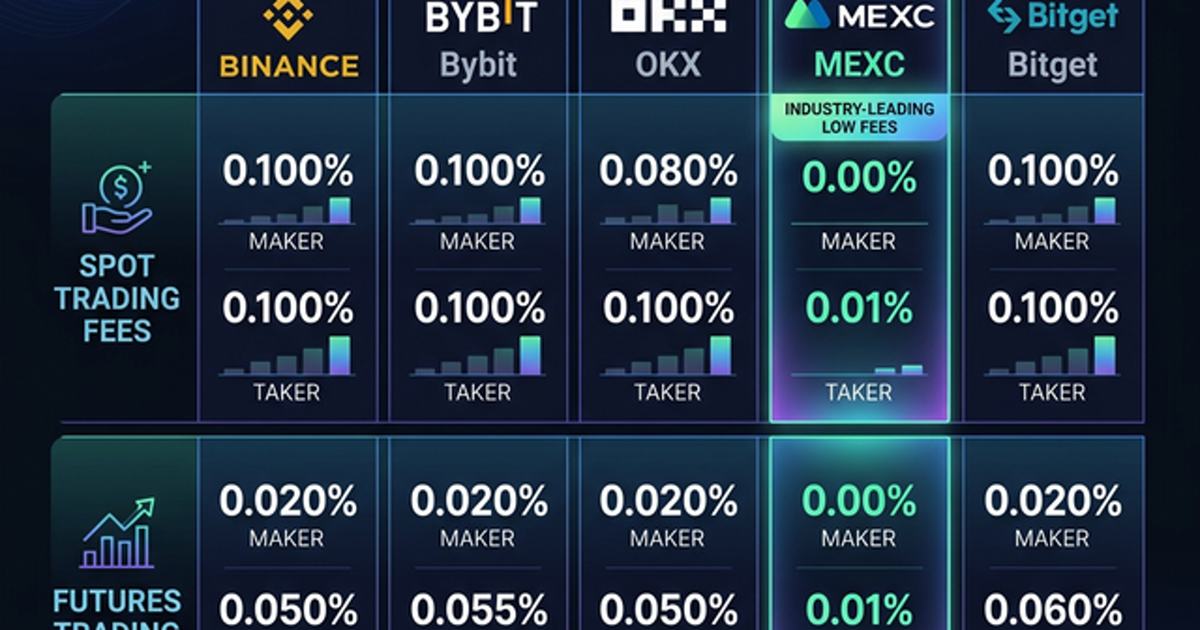
Fee structures vary significantly between exchanges, and understanding these differences is essential for optimizing your trading costs and cashback earnings.
Complete Fee Comparison: Spot Markets
| Exchange | Maker Fee | Taker Fee | Fee Gap | Maker with Token Discount | Taker with Token Discount |
|---|---|---|---|---|---|
| Binance | 0.100% | 0.100% | 0.000% | 0.075% (BNB -25%) | 0.075% (BNB -25%) |
| Bybit | 0.100% | 0.100% | 0.000% | 0.100% (no discount) | 0.100% (no discount) |
| OKX | 0.080% | 0.100% | 0.020% | 0.060% (OKB holders) | 0.080% (OKB holders) |
| MEXC | 0.000% | 0.050% | 0.050% | 0.000% (always free) | 0.050% (no change) |
| Bitget | 0.100% | 0.100% | 0.000% | 0.080% (BGB -20%) | 0.080% (BGB -20%) |
Key observations for spot markets:
- MEXC offers the widest maker-taker gap with completely free maker orders and 0.050% taker fees
- Binance, Bybit, and Bitget have no maker-taker differential at the base tier (both 0.100%)
- OKX provides a small 0.020% advantage for makers at the base level
Complete Fee Comparison: Futures (Perpetual) Markets
| Exchange | Maker Fee | Taker Fee | Fee Gap | Effective Maker After 20% CB | Effective Taker After 20% CB |
|---|---|---|---|---|---|
| Binance | 0.020% | 0.050% | 0.030% | 0.016% | 0.040% |
| Bybit | 0.020% | 0.055% | 0.035% | 0.016% | 0.044% |
| OKX | 0.020% | 0.050% | 0.030% | 0.016% | 0.040% |
| MEXC | 0.000% | 0.010% | 0.010% | 0.000% | 0.008% |
| Bitget | 0.020% | 0.060% | 0.040% | 0.016% | 0.048% |
Key observations for futures markets:
- Every exchange offers lower maker fees than taker fees in futures
- Bitget has the widest gap (0.040%) between maker and taker in futures
- MEXC again leads with 0% maker fees, making futures maker orders completely free
- After applying 20% cashback, the effective cost difference becomes even more pronounced
Fee Tiers: How Volume Affects Maker-Taker Spreads
Most exchanges offer tiered fee structures where high-volume traders unlock progressively lower rates. Importantly, the maker-taker gap usually widens at higher tiers, providing even greater incentives for maker orders.
| Exchange | Tier | 30-Day Volume | Spot Maker | Spot Taker | Gap |
|---|---|---|---|---|---|
| Binance | Regular | < $1M | 0.100% | 0.100% | 0.000% |
| Binance | VIP 1 | >= $1M | 0.090% | 0.100% | 0.010% |
| Binance | VIP 2 | >= $5M | 0.080% | 0.100% | 0.020% |
| Binance | VIP 3 | >= $10M | 0.042% | 0.060% | 0.018% |
| Binance | VIP 4 | >= $25M | 0.042% | 0.054% | 0.012% |
At Binance VIP 3 level, the maker fee drops to 0.042%, while taker remains at 0.060%. Combined with 20% cashback, the effective maker fee becomes just 0.034%, saving $6.60 per $10,000 traded compared to the regular taker rate.
How Cashback Applies to Maker and Taker Fees
Your 20% cashback through cashback.day is calculated on the total trading fee you pay, regardless of whether it was a maker or taker fee. This creates an interesting dynamic when optimizing your strategy.
Cashback Calculation for Each Fee Type
| Exchange | Fee Type | Fee Rate | Fee on $10,000 Trade | 20% Cashback | Net Fee After CB |
|---|---|---|---|---|---|
| Binance | Maker (spot) | 0.100% | $10.00 | $2.00 | $8.00 |
| Binance | Taker (spot) | 0.100% | $10.00 | $2.00 | $8.00 |
| MEXC | Maker (spot) | 0.000% | $0.00 | $0.00 | $0.00 |
| MEXC | Taker (spot) | 0.050% | $5.00 | $1.00 | $4.00 |
| Binance | Maker (futures) | 0.020% | $2.00 | $0.40 | $1.60 |
| Binance | Taker (futures) | 0.050% | $5.00 | $1.00 | $4.00 |
| MEXC | Maker (futures) | 0.000% | $0.00 | $0.00 | $0.00 |
| MEXC | Taker (futures) | 0.010% | $1.00 | $0.20 | $0.80 |
The Maker-Taker Cashback Paradox
Here is where it gets interesting: taker orders generate higher absolute cashback amounts because they incur higher fees. A Binance futures taker order on a $100,000 position generates $1.00 in cashback, while a maker order generates only $0.40. On the surface, it seems like taker orders are better for cashback.
But this is a trap. The total cost analysis reveals the truth:
| Strategy | Fee Paid | Cashback | Net Cost | Annual Net Cost (100 trades/month) |
|---|---|---|---|---|
| Always Taker (0.050%) | $50.00 | $10.00 | $40.00 | $48,000 |
| Always Maker (0.020%) | $20.00 | $4.00 | $16.00 | $19,200 |
| Mixed (50/50) | $35.00 | $7.00 | $28.00 | $33,600 |
The always-maker strategy saves $28,800 per year compared to the always-taker strategy, even though it generates less total cashback. Your goal should be to minimize total net fees, not to maximize cashback amounts. Cashback is a bonus on top of already-optimized trading costs.
MEXC Special Case: Zero-Cost Trading
MEXC deserves special mention because it offers 0% maker fees on both spot and futures markets. When you use limit orders on MEXC:
- You pay $0 in trading fees
- You receive $0 in cashback (20% of $0 = $0)
- Your net trading cost is $0
This makes MEXC the only exchange where you can trade with literally zero cost using maker orders. For high-frequency traders, this advantage is enormous.
Practical Strategies for Optimizing Maker-Taker Cashback
Strategy 1: The Post-Only Method
Use post-only orders for every entry and exit. This guarantees you always receive maker classification, ensuring you never accidentally pay taker fees. Available on Binance, Bybit, OKX, MEXC, and Bitget.
How to set post-only on major exchanges:
- Binance: Select "Limit" order type, then check "Post Only" box
- Bybit: Choose "Limit" order, toggle "Post-Only"
- OKX: Select "Limit" order, enable "Post-Only" option
- MEXC: Choose "Limit" order, select "Post Only" execution type
- Bitget: Select "Limit" order, toggle "Post Only"
The trade-off is that your order may not fill if the price moves away from your limit. For time-sensitive entries, you may need to accept taker fees occasionally.
Strategy 2: Split Large Orders into Maker-Taker Mix
For positions requiring immediate execution (such as during volatile breakouts), split your order:
- Place 60-70% as a limit order slightly below market (maker)
- Execute the remaining 30-40% as a market order (taker)
This captures most of the position immediately while benefiting from lower fees on the majority of the order. Example with a $100,000 futures position on Binance:
| Component | Size | Fee Type | Fee Rate | Fee Paid | 20% CB | Net Fee |
|---|---|---|---|---|---|---|
| Maker portion | $70,000 | Maker | 0.020% | $14.00 | $2.80 | $11.20 |
| Taker portion | $30,000 | Taker | 0.050% | $15.00 | $3.00 | $12.00 |
| Total | $100,000 | Mixed | 0.029% | $29.00 | $5.80 | $23.20 |
| If 100% taker | $100,000 | Taker | 0.050% | $50.00 | $10.00 | $40.00 |
The split approach saves $16.80 per $100,000 traded compared to pure taker execution. Over a month of active trading, this adds up to thousands of dollars.
Strategy 3: Exchange Selection Based on Fee Structure
Choose different exchanges for different order types to minimize total costs:
| Trading Style | Best Exchange | Reason |
|---|---|---|
| Always limit orders (maker) | MEXC | 0% maker fee = $0 trading cost |
| Primarily market orders (taker) | MEXC | 0.01% taker fee (lowest in industry) |
| Mixed maker/taker | Binance + BNB | 0.075% uniform rate with discount |
| High-volume futures | MEXC or Binance | Lowest effective rates after CB |
| Copy trading | Bitget | CB applies to copied trades too |
Strategy 4: Timing Your Orders for Maker Classification
During periods of high volatility, the spread between bid and ask prices widens, making it easier to place limit orders that sit on the book (maker classification). Conversely, in tight markets, the spread narrows and limit orders may fill immediately (taker classification).
Tips for achieving maker status:
- Place limit orders 0.1-0.3% below the current price for buys (or above for sells)
- Use post-only mode to guarantee maker status
- Avoid placing limit orders at the current best bid/ask price
- During high volatility, you can place tighter limits and still get maker classification
Strategy 5: Accumulate Volume for Fee Tier Upgrades
As your trading volume increases, you unlock lower fee tiers that typically benefit maker orders more than taker orders. To accelerate tier progression:
- Consolidate trading on one or two exchanges rather than spreading across many
- Focus high-frequency strategies on your primary exchange
- Use futures trading (with leverage) to accumulate volume faster
- Combine volume from spot and futures on the same exchange
With each tier upgrade, your maker fees decrease, your total costs drop, and your cashback becomes relatively more valuable as a percentage of your reduced fees.
Annual Savings Analysis: Maker vs Taker Approach
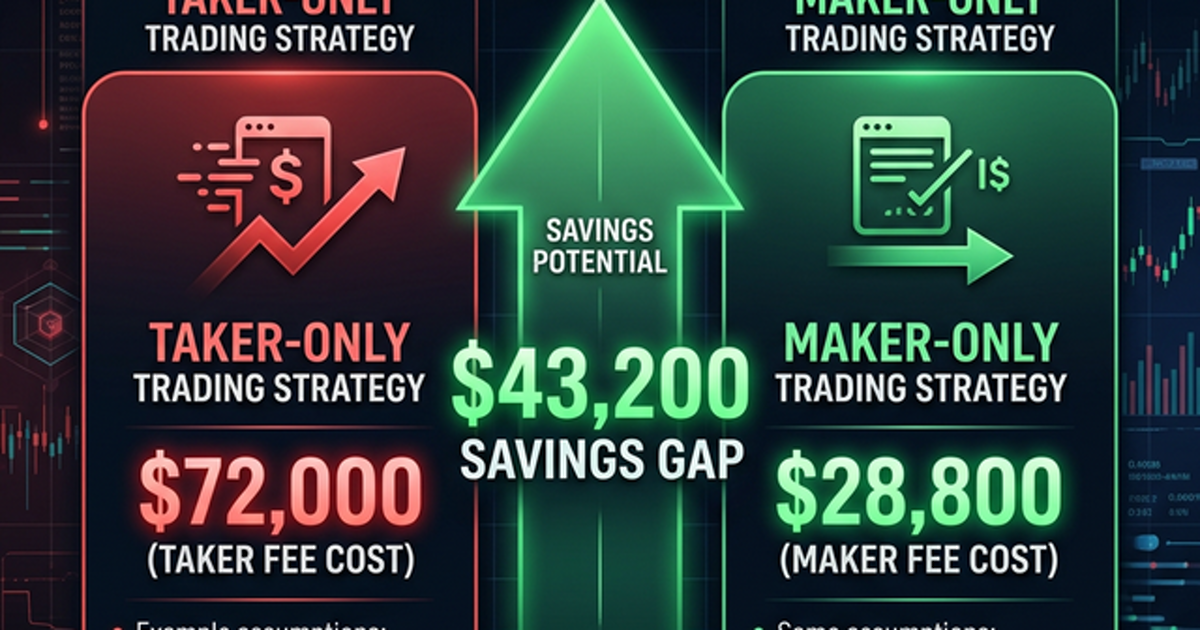
Let us calculate the annual difference for a typical active trader using each approach.
Scenario: Active Futures Trader on Binance
Trading capital: $30,000, average leverage: 10x, 2 trades per day, 300 trading days per year.
| Approach | Fee Rate | Cost Per Trade | Annual Trades | Annual Fees | 20% CB | Net Annual Cost |
|---|---|---|---|---|---|---|
| All Taker | 0.050% | $150.00 | 600 | $90,000 | $18,000 | $72,000 |
| All Maker | 0.020% | $60.00 | 600 | $36,000 | $7,200 | $28,800 |
| 70/30 Mix | 0.029% | $87.00 | 600 | $52,200 | $10,440 | $41,760 |
The all-maker approach saves $43,200 per year in net fees compared to all-taker. Even the 70/30 mixed approach saves $30,240 per year.
Scenario: Active Futures Trader on MEXC
Same parameters but using MEXC fees:
| Approach | Fee Rate | Cost Per Trade | Annual Fees | 20% CB | Net Annual Cost |
|---|---|---|---|---|---|
| All Taker | 0.010% | $30.00 | $18,000 | $3,600 | $14,400 |
| All Maker | 0.000% | $0.00 | $0 | $0 | $0 |
| 70/30 Mix | 0.003% | $9.00 | $5,400 | $1,080 | $4,320 |
On MEXC with all-maker orders, total annual trading cost is literally zero dollars. This is the theoretical minimum achievable cost in crypto trading.
Scenario: Casual Spot Trader on Binance
Trading capital: $10,000, no leverage, 10 trades per month, 12 months per year.
| Approach | Fee Rate | Cost Per Trade | Annual Trades | Annual Fees | 20% CB | Net Annual Cost |
|---|---|---|---|---|---|---|
| All Taker | 0.100% | $10.00 | 120 | $1,200 | $240 | $960 |
| All Maker | 0.100% | $10.00 | 120 | $1,200 | $240 | $960 |
| With BNB Taker | 0.075% | $7.50 | 120 | $900 | $180 | $720 |
| With BNB Maker | 0.075% | $7.50 | 120 | $900 | $180 | $720 |
At Binance base tier for spot, maker and taker are the same rate. The BNB discount provides value here regardless of order type. For spot traders on Binance, switching to MEXC for maker orders provides bigger savings ($0 fees vs $720).
Hidden Benefits of Maker Orders Beyond Lower Fees
Better Price Execution
Maker orders often result in better average fill prices. When you set a limit buy at $59,500 instead of buying at market ($60,000), you save 0.83% on the entry price alone, which far exceeds any fee difference. Over time, this price improvement dramatically increases trading profitability.
Reduced Slippage
Market orders on large positions can cause significant slippage, especially in less liquid markets. A $500,000 market order on a mid-cap altcoin might move the price 0.05-0.20%, costing $250-$1,000 in slippage on top of the taker fee. Limit orders eliminate slippage entirely because you set the exact execution price.
Emotional Discipline
Using maker orders forces you to decide your entry and exit prices in advance. This promotes disciplined trading behavior and prevents the emotional decisions that often accompany market orders during volatile price movements.
Funding Rate Optimization
In futures trading, placing maker orders for entry gives you time to evaluate funding rates before your position opens. If funding rates are extremely high, your limit order provides the opportunity to cancel before execution, whereas a market order commits immediately.
Advanced Maker-Taker Strategies for Maximum Cashback
The Iceberg Strategy
For large orders, use iceberg or hidden order types that show only a small portion of your total order on the book. Each visible slice executes as a maker order, but the total position builds gradually without impacting the market price. This maintains maker fee status while accumulating large positions.
The Grid Trading Approach
Place multiple limit orders at different price levels (grid trading). Each order that fills is classified as a maker order, earning the lower fee rate. When prices oscillate within a range, your grid captures profit on each swing while consistently paying maker fees. Some exchanges offer built-in grid trading bots that automate this strategy.
Combined with 20% cashback, grid trading on MEXC becomes essentially cost-free since all orders pay 0% maker fees.
The Dual-Exchange Strategy
Use MEXC for all maker orders (0% fees) and Binance for necessary taker orders (benefit from BNB discount + cashback). This hybrid approach gives you:
- Zero cost on planned entries and exits (MEXC maker)
- Minimized cost on urgent executions (Binance taker with BNB + 20% CB)
- Volume accumulation on both exchanges for tier progression
Register on both exchanges through cashback.day to ensure 20% cashback on all trades across both platforms.
Common Mistakes Traders Make with Maker-Taker Fees
Mistake 1: Always Using Market Orders
The most common and costly mistake is defaulting to market orders for convenience. While market orders provide instant execution, the cumulative fee difference over a year can amount to tens of thousands of dollars. Train yourself to use limit orders as the default, resorting to market orders only when instant execution is truly necessary.
Mistake 2: Setting Limit Orders Too Close to Market Price
If your limit order is at or better than the current best bid/ask, it may execute immediately as a taker order. Always check the current order book depth and place your limit at least one tick away from the best price to ensure maker classification.
Mistake 3: Ignoring Fee Tiers
Many traders spread their volume across multiple exchanges, never reaching higher fee tiers on any of them. Consolidating volume on one or two exchanges unlocks lower maker fees that compound with cashback for significant savings.
Mistake 4: Choosing Exchanges Based on Marketing, Not Fees
Some exchanges attract users with bonuses and promotions while charging higher base fees. Always compare the actual fee structures. MEXC with 0% maker fees outperforms any exchange offering temporary bonus packages.
Mistake 5: Not Using Post-Only Orders
Many traders use regular limit orders without realizing they can become taker orders if the price moves. Enable post-only mode to guarantee maker classification on every limit order. This simple setting can save you significant money over time.
FAQ: Maker-Taker Fees and Cashback
Does cashback apply to both maker and taker fees?
Yes, your 20% cashback through cashback.day applies to all trading fees, whether maker or taker. The cashback is calculated as 20% of whatever fee you pay. If you pay a $10 taker fee, you get $2 cashback. If you pay a $2 maker fee, you get $0.40 cashback.
Which order type earns more total cashback?
Taker orders generate higher absolute cashback amounts because they incur higher fees. However, this does not mean taker orders are better. The goal is to minimize total net cost (fees minus cashback), and maker orders almost always achieve lower net costs.
Can I get negative maker fees (rebates)?
Some exchanges at very high VIP tiers offer negative maker fees, meaning they pay you to place maker orders. At these levels, you earn money from the exchange for providing liquidity, plus you earn cashback on any positive fees you do pay. Check specific exchange VIP tier requirements for details.
How do maker-taker fees work in futures vs spot?
The same maker-taker principle applies to both spot and futures markets, but futures consistently offer lower base rates for both fee types. Futures maker fees typically range from 0% to 0.02%, while spot maker fees range from 0% to 0.10%.
Do funding rates count as maker or taker fees?
Funding rates are separate from trading fees and are not classified as maker or taker. They are periodic payments between long and short holders of perpetual futures contracts. Funding rate payments do not generate cashback because they are not trading fees.
Conclusion: Maker Orders Are the Foundation of Smart Trading
The data is unambiguous: consistently using maker orders is one of the most effective ways to reduce trading costs, regardless of which exchange you use. When combined with 20% cashback from cashback.day, the savings compound dramatically.
For futures traders on Binance, switching from taker to maker orders saves $43,200 per year in net fees on a typical active trading profile. On MEXC, maker orders eliminate all trading costs entirely, achieving the theoretical minimum of zero fees.
The optimal strategy combines several elements: use post-only orders to guarantee maker status, select exchanges with the lowest maker fees (MEXC for zero fees, Binance with BNB for situations requiring taker orders), and register through cashback.day on all exchanges to earn 20% cashback on whatever fees you do pay.
Start optimizing your trading fees today. Compare exchange cashback rates on our crypto cashback comparison page, and read our detailed guides for saving on fees at Binance, Bybit, and other supported exchanges.
Related reading: Crypto Trading Fees Explained | Spot vs Futures Crypto Cashback | How to Save 40% on Binance Fees | 7 Ways to Lower Crypto Exchange Fees