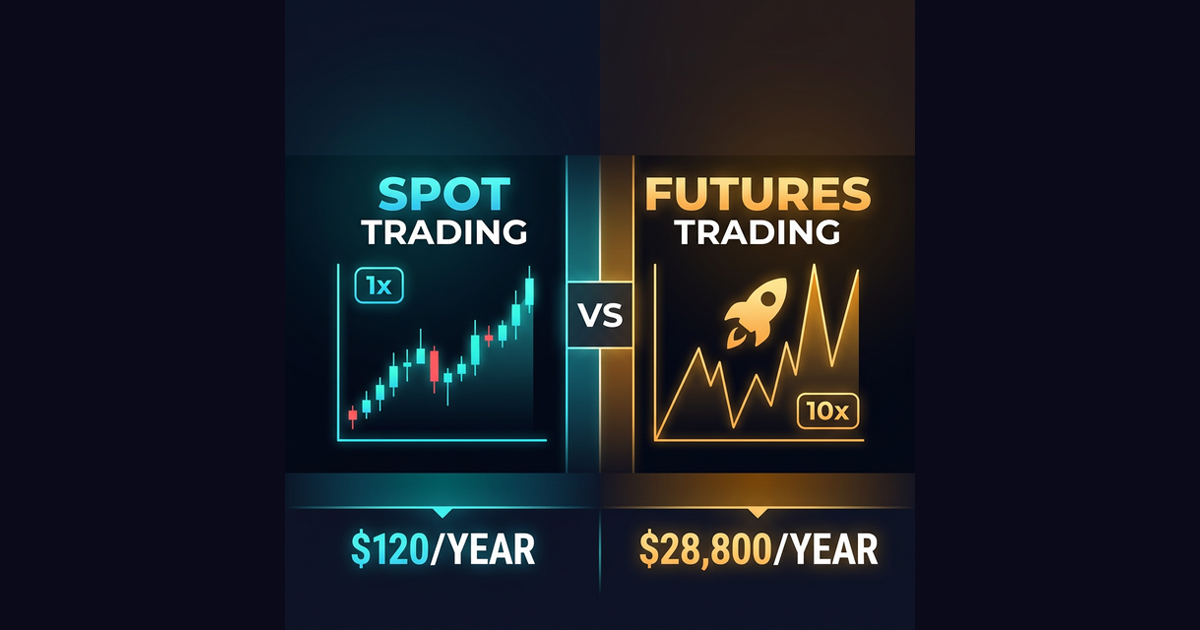
Quick Answer: Spot and Futures Both Earn 20% Cashback, But Futures Wins on Total Savings
Both spot and futures trading qualify for the same 20% cashback rate through cashback.day affiliate rebate programs. However, futures traders consistently earn significantly more cashback in absolute dollar terms. The reason is straightforward: leverage amplifies your trading volume without requiring additional capital, futures base fees are lower (allowing more frequent trading), and active futures traders naturally generate higher monthly volumes.
Consider this: a trader with $10,000 in capital trading spot at 0.10% fees pays $10 per $10,000 trade and receives $2 in cashback. That same trader using 10x leverage on futures controls a $100,000 position, pays $50 in fees at 0.05%, and receives $10 in cashback. Same capital, five times the cashback. Over a year of active trading, this difference compounds into thousands of dollars.
This analysis breaks down exactly how spot and futures cashback compare across every major exchange, with real calculations showing annual savings for different trading styles. Whether you trade spot exclusively, focus on futures, or combine both markets, you will learn how to maximize your fee rebates through cashback.day.
Understanding Spot Trading Fees and Cashback Mechanics
Spot trading is the most straightforward form of cryptocurrency trading. You buy Bitcoin at the current market price, you own Bitcoin. You sell Ethereum, you receive USDT or another quote currency. Every spot trade incurs a trading fee, and these fees are where cashback programs create value for traders.
How Spot Fees Are Calculated
Spot trading fees on major exchanges typically follow a maker-taker model:
| Exchange | Maker Fee | Taker Fee | Fee With BNB/Token Discount |
|---|---|---|---|
| Binance | 0.100% | 0.100% | 0.075% (25% BNB discount) |
| Bybit | 0.100% | 0.100% | 0.100% (no token discount) |
| OKX | 0.080% | 0.100% | 0.060% (OKB holding) |
| MEXC | 0.000% | 0.050% | 0.000% maker always free |
| Bitget | 0.100% | 0.100% | 0.080% (BGB discount) |
When you place a limit order that does not execute immediately (it sits on the order book waiting to be filled), you pay the maker fee. When you place a market order or a limit order that executes immediately against an existing order, you pay the taker fee. Most casual traders use market orders, so they pay the taker fee on every trade.
How Spot Cashback Works
When you register on an exchange through a cashback.day referral link, the exchange shares a portion of the trading fees you generate with cashback.day. We then pass 20% of those fees back to you as a cashback rebate. This process is fully automatic:
You trade normally on the exchange (spot, futures, or any supported market)
The exchange calculates trading fees on each transaction
Cashback accrues automatically to your rebate balance
Rebates are paid weekly in USDT directly to your exchange wallet
For spot trading specifically, the cashback amount per trade equals: Position Size multiplied by Fee Rate multiplied by 20% Cashback Rate. On a $10,000 spot trade at Binance with a 0.10% taker fee, your fee is $10.00 and your cashback is $2.00. This effectively reduces your trading fee from 0.10% to 0.080%.
Spot Cashback Scenarios by Volume
| Monthly Spot Volume | Avg Fee Rate | Monthly Fees | 20% Cashback | Annual Cashback |
|---|---|---|---|---|
| $10,000 | 0.10% | $10 | $2 | $24 |
| $50,000 | 0.10% | $50 | $10 | $120 |
| $100,000 | 0.10% | $100 | $20 | $240 |
| $500,000 | 0.10% | $500 | $100 | $1,200 |
| $1,000,000 | 0.08% | $800 | $160 | $1,920 |
Most casual spot traders fall in the $10,000 to $100,000 monthly volume range, earning $24 to $240 per year in cashback. While this is essentially free money, it is modest compared to what futures traders earn, as we will see in the next section.
Understanding Futures Trading Fees and the Leverage Multiplier Effect
Futures trading introduces two game-changing variables for cashback earnings: leverage and lower base fees. Together, these create a multiplier effect that dramatically increases the total cashback a trader can earn relative to their capital.
How Futures Fees Differ From Spot
Futures fees are structured differently from spot fees in several important ways:
| Characteristic | Spot | Futures (Perpetual) |
|---|---|---|
| Fee Basis | Trade notional value | Position notional value |
| Maker Fee Range | 0.05-0.10% | 0.00-0.02% |
| Taker Fee Range | 0.05-0.10% | 0.01-0.055% |
| Fee Charged On | Actual capital used | Leveraged position size |
| Additional Costs | None | Funding rate (every 8h) |
| Volume Potential | Limited by capital | Amplified by leverage |
The critical distinction is that futures fees are calculated on the notional value of your position, not on the margin you put up. When you open a $100,000 futures position with $10,000 margin (10x leverage), the exchange charges fees on the full $100,000. This means your cashback is also calculated on this larger amount.
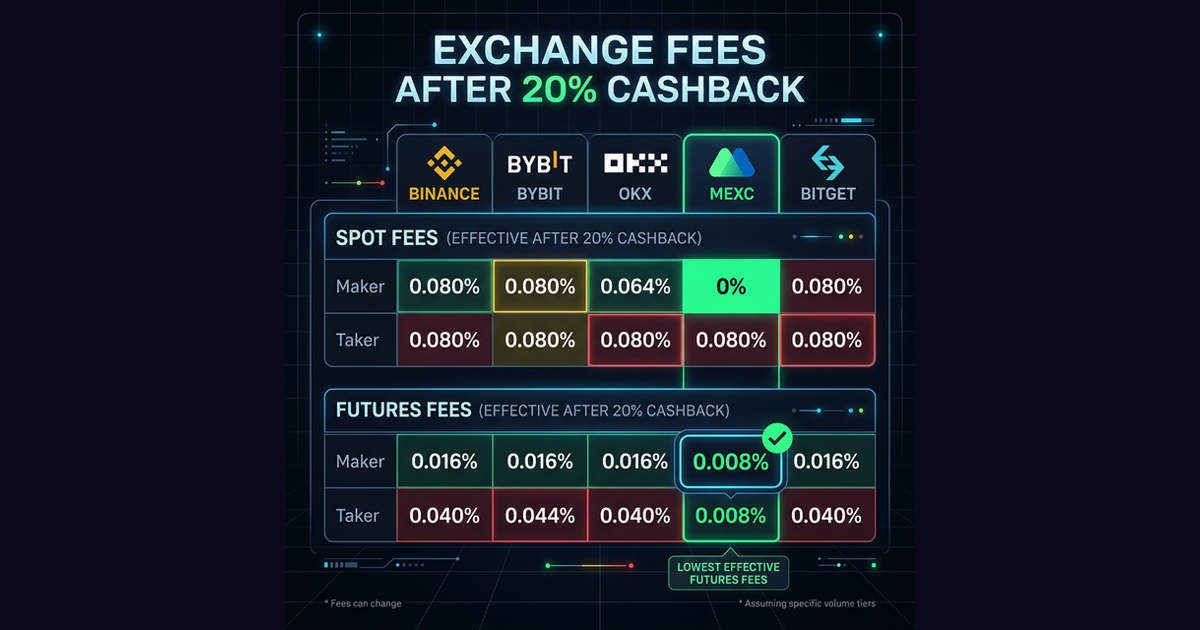
Futures Fee Comparison Across Exchanges
| Exchange | Futures Maker | Futures Taker | Effective Taker After 20% CB |
|---|---|---|---|
| Binance | 0.020% | 0.050% | 0.040% |
| Bybit | 0.020% | 0.055% | 0.044% |
| OKX | 0.020% | 0.050% | 0.040% |
| MEXC | 0.000% | 0.010% | 0.008% |
| Bitget | 0.020% | 0.060% | 0.048% |
MEXC stands out with 0% maker fees and just 0.01% taker fees on futures, making it the cheapest exchange for derivatives trading. After applying 20% cashback, the effective taker fee drops to an incredibly low 0.008%. For more details on MEXC fee structures, see our MEXC trading fee rebate guide.
The Leverage Multiplier: Why Futures Cashback Is Significantly Higher
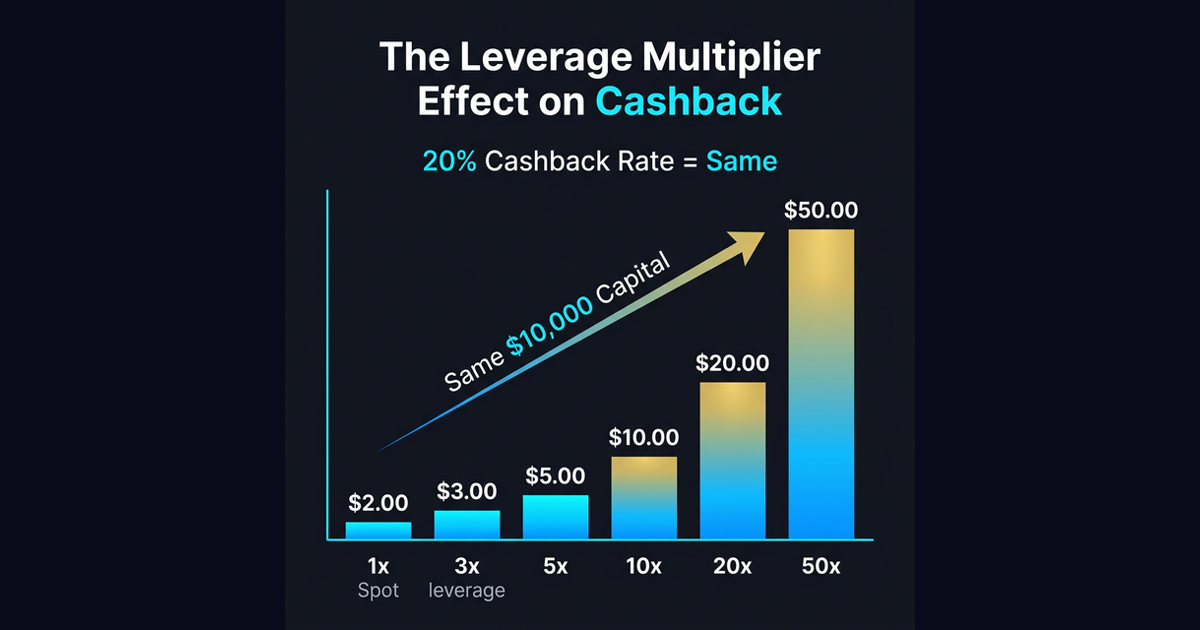
Leverage is the single biggest reason futures traders earn more cashback than spot traders with the same capital. Here is how the math works with $10,000 in trading capital:
| Leverage | Position Size | Fee Rate (Taker) | Fee Per Trade | 20% Cashback | CB Multiple vs Spot |
|---|---|---|---|---|---|
| 1x (Spot) | $10,000 | 0.10% | $10.00 | $2.00 | 1.0x |
| 3x | $30,000 | 0.05% | $15.00 | $3.00 | 1.5x |
| 5x | $50,000 | 0.05% | $25.00 | $5.00 | 2.5x |
| 10x | $100,000 | 0.05% | $50.00 | $10.00 | 5.0x |
| 20x | $200,000 | 0.05% | $100.00 | $20.00 | 10.0x |
| 50x | $500,000 | 0.05% | $250.00 | $50.00 | 25.0x |
With just 10x leverage (a moderate amount for futures), you earn 5 times more cashback per trade compared to spot, even though the futures fee rate is half the spot fee rate. This leverage multiplier effect is the primary driver of higher futures cashback.
It is important to note that leverage also amplifies risk. Higher leverage means smaller price movements can liquidate your position. This analysis focuses purely on the fee and cashback mathematics. Traders should always use risk management practices appropriate for their experience level. For a deeper understanding of how trading fees work across different order types, read our comprehensive guide on crypto trading fees explained.
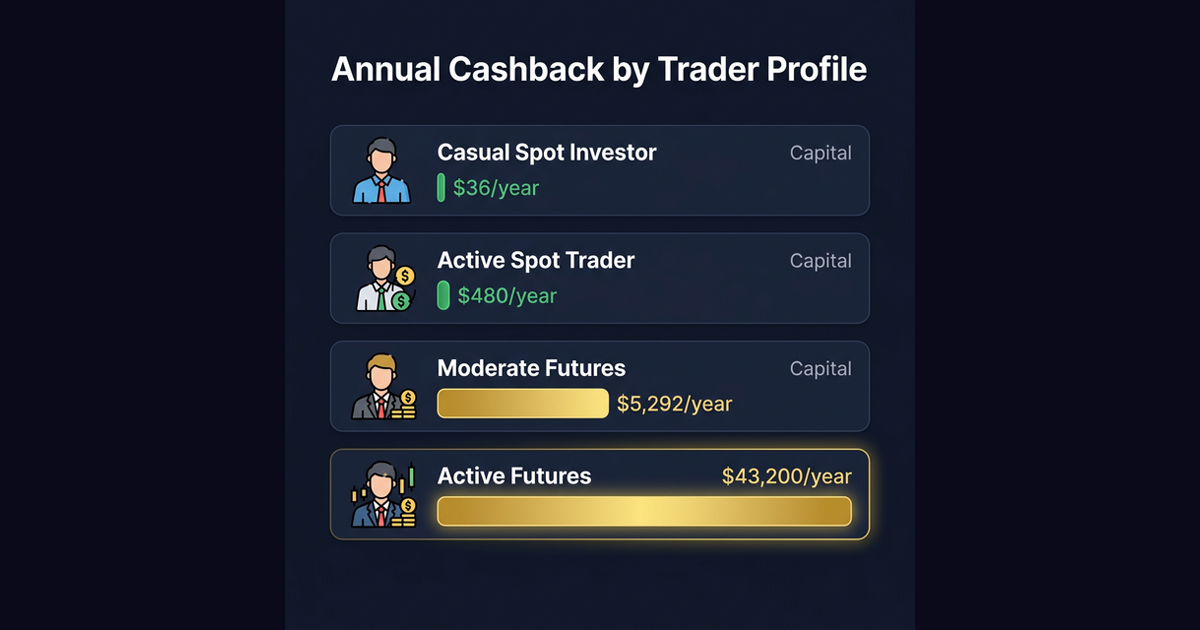
Annual Cashback Projection: Four Real Trader Profiles
To make this comparison tangible, let us examine four realistic trader profiles and calculate their annual cashback earnings.
Profile 1: Casual Spot Investor
This trader buys and holds cryptocurrency, making 2-4 spot purchases per month.
| Parameter | Value |
|---|---|
| Monthly Capital Deployed | $5,000 |
| Trades Per Month | 3 (buy only, hold) |
| Monthly Volume | $15,000 |
| Average Fee Rate | 0.10% |
| Monthly Fees | $15.00 |
| Monthly Cashback (20%) | $3.00 |
| Annual Cashback | $36.00 |
Profile 2: Active Spot Trader
This trader actively trades spot markets, buying and selling multiple times per week.
| Parameter | Value |
|---|---|
| Trading Capital | $20,000 |
| Trades Per Day | 2-3 round trips |
| Monthly Volume | $200,000 |
| Average Fee Rate | 0.10% |
| Monthly Fees | $200.00 |
| Monthly Cashback (20%) | $40.00 |
| Annual Cashback | $480.00 |
Profile 3: Moderate Futures Trader
This trader uses 5-10x leverage, opening 1-2 positions per day.
| Parameter | Value |
|---|---|
| Trading Capital | $20,000 |
| Average Leverage | 7x |
| Average Position Size | $140,000 |
| Trades Per Day | 1.5 |
| Monthly Volume | $6,300,000 |
| Average Fee Rate (Blended) | 0.035% |
| Monthly Fees | $2,205.00 |
| Monthly Cashback (20%) | $441.00 |
| Annual Cashback | $5,292.00 |
Profile 4: Active Futures Trader
This trader uses 10-20x leverage, actively scalping or day trading with multiple positions daily.
| Parameter | Value |
|---|---|
| Trading Capital | $50,000 |
| Average Leverage | 10x |
| Average Position Size | $500,000 |
| Trades Per Day | 3 |
| Monthly Volume | $45,000,000 |
| Average Fee Rate (Blended) | 0.04% |
| Monthly Fees | $18,000.00 |
| Monthly Cashback (20%) | $3,600.00 |
| Annual Cashback | $43,200.00 |
Summary: Annual Cashback by Trader Profile
| Profile | Capital | Annual Volume | Annual Fees | Annual Cashback | CB as % of Capital |
|---|---|---|---|---|---|
| Casual Spot | $5,000 | $180,000 | $180 | $36 | 0.72% |
| Active Spot | $20,000 | $2,400,000 | $2,400 | $480 | 2.40% |
| Moderate Futures | $20,000 | $75,600,000 | $26,460 | $5,292 | 26.46% |
| Active Futures | $50,000 | $540,000,000 | $216,000 | $43,200 | 86.40% |
The difference is staggering. An active futures trader with $50,000 in capital can earn $43,200 per year in cashback alone, essentially recovering 86% of their initial capital through fee rebates. Meanwhile, a casual spot investor with $5,000 earns just $36 per year.
Exchange-by-Exchange Deep Dive: Spot vs Futures Cashback
Each exchange has different fee structures that affect the spot versus futures cashback equation. Here is a detailed analysis of the five major exchanges supported by cashback.day.
Binance: The Volume Leader
Binance offers the highest liquidity in both spot and futures markets, making it the default choice for many traders.
| Market | Maker | Taker | With BNB | After 20% CB (Taker) |
|---|---|---|---|---|
| Spot | 0.100% | 0.100% | 0.075% | 0.060% (with BNB) |
| USDT-M Futures | 0.020% | 0.050% | N/A | 0.040% |
| COIN-M Futures | 0.010% | 0.050% | N/A | 0.040% |
Binance spot with BNB discount combined with 20% cashback produces the best spot-specific effective rate at 0.060%. For futures, the effective taker rate drops to 0.040% after cashback, making Binance competitive but not the cheapest option for futures.
Binance advantage: BNB discount stacks with cashback on spot. This is the only exchange where a token discount and cashback combine for spot trading. Learn more in our detailed Binance trading fee cashback guide.
MEXC: Lowest Futures Fees in the Industry
MEXC has positioned itself as the low-fee leader, particularly for futures trading.
| Market | Maker | Taker | After 20% CB (Taker) |
|---|---|---|---|
| Spot | 0.000% | 0.050% | 0.040% |
| Futures | 0.000% | 0.010% | 0.008% |
MEXC futures are remarkably cheap: 0% maker fees and just 0.01% taker fees. After 20% cashback, the effective taker cost is only 0.008%. For high-volume futures traders, this translates into massive savings compared to other exchanges. Even the spot market offers 0% maker fees, making MEXC an excellent choice for limit order traders. Check our MEXC trading fee rebate guide for step-by-step setup instructions.
Bybit: Strong All-Around Performance
Bybit is popular among futures traders for its user interface and derivatives product range.
| Market | Maker | Taker | After 20% CB (Taker) |
|---|---|---|---|
| Spot | 0.100% | 0.100% | 0.080% |
| Futures | 0.020% | 0.055% | 0.044% |
Bybit futures taker fees (0.055%) are slightly higher than Binance (0.050%), resulting in a slightly higher effective rate after cashback at 0.044%. However, Bybit compensates with a broad range of perpetual contracts, copy trading features, and competitive maker fees. Learn more about Bybit fee structures and how to earn USDT cashback on every trade in our Bybit USDT fee cashback guide.
OKX: Competitive With Token Benefits
OKX offers competitive fees that can be further reduced through OKB token staking.
| Market | Maker | Taker | After 20% CB (Taker) |
|---|---|---|---|
| Spot | 0.080% | 0.100% | 0.080% |
| Futures | 0.020% | 0.050% | 0.040% |
OKX matches Binance on futures pricing after cashback at 0.040% effective taker rate. The spot maker fee of 0.080% is already lower than most competitors. OKX also offers unified account margin, allowing traders to use spot holdings as futures margin, which can improve capital efficiency.
Bitget: Copy Trading Advantage
Bitget differentiates itself with a strong copy trading ecosystem where cashback applies to copied trades as well.
| Market | Maker | Taker | After 20% CB (Taker) |
|---|---|---|---|
| Spot | 0.100% | 0.100% | 0.080% |
| Futures | 0.020% | 0.060% | 0.048% |
Bitget futures taker fees are slightly higher than competitors at 0.060%, but the copy trading feature means even passive traders can generate significant volume (and cashback) by following experienced traders. This is particularly valuable for traders who want futures exposure without active management. For a detailed analysis of how copy trading cashback works on Bitget, see our Bitget copy trading fee rebate guide.
When Spot Cashback Actually Makes More Sense
Despite futures generating higher total cashback, there are legitimate scenarios where spot trading cashback is the better choice for certain traders.
Scenario 1: Long-Term Investors (HODLers)
If your strategy is to accumulate Bitcoin, Ethereum, or other assets for long-term holding, you do not need leverage. Futures contracts have ongoing costs (funding rates every 8 hours) and the risk of liquidation. For buy-and-hold investors, spot cashback is pure savings with zero additional risk.
Practical tip: Use limit orders on MEXC (0% maker fee + 20% cashback = effectively free trading) or Binance with BNB discount (0.075% - 20% cashback = 0.060% effective fee) for maximum spot savings.
Scenario 2: Risk-Averse Traders
Leverage amplifies both gains and losses. Traders who prefer lower risk profiles benefit from spot trading where the maximum loss is limited to the capital invested. The cashback from spot trading, while smaller in absolute terms, comes without any leverage-related liquidation risk.
Scenario 3: Regulatory Considerations
In some jurisdictions (such as Canada, United Kingdom, or parts of the European Union), access to crypto futures and leverage products may be restricted for retail traders. In these markets, spot trading with cashback is the only available fee reduction option.
Scenario 4: Small Account Sizes
For traders with less than $1,000 in capital, the complexity of futures trading (managing margin, monitoring liquidation prices, understanding funding rates) may not justify the additional cashback. At $500 capital with 5x leverage, the cashback difference versus spot is only a few dollars per month.
The Optimal Strategy: Combining Spot and Futures Cashback
The most efficient approach for experienced traders is to use both markets strategically, maximizing cashback while managing risk appropriately.
Strategy 1: Core-Satellite Approach
Allocate 60-70% of capital to spot holdings (core portfolio) and 30-40% to futures trading (satellite). This structure provides:
- Consistent spot cashback on your core holdings
- Amplified cashback from leveraged futures on a smaller portion of capital
- Reduced overall portfolio risk compared to going all-in on futures
- Estimated annual cashback: 8-15% of total capital
Strategy 2: Spot Accumulation + Futures Hedging
Use spot purchases for long-term accumulation and futures for short-term hedging or speculation. Open a spot long position and hedge with a small futures short during uncertain markets. Both positions generate trading fees, and both earn 20% cashback.
Strategy 3: Exchange Diversification for Maximum Cashback
Use different exchanges for different market types:
- MEXC for futures: Take advantage of 0% maker fees and 0.01% taker fees
- Binance for spot: Use BNB discount combined with 20% cashback
- Bybit for copy trading: Earn cashback on copied futures trades passively
All three exchanges are supported by cashback.day, and registering through our referral links ensures 20% cashback on each.
Strategy 4: Maker Order Priority
Across both spot and futures, consistently using limit orders (maker) instead of market orders (taker) reduces your fees significantly. Combined with 20% cashback:
| Order Type | Spot Fee | After CB | Futures Fee | After CB |
|---|---|---|---|---|
| Taker (Market) | 0.10% | 0.080% | 0.05% | 0.040% |
| Maker (Limit) | 0.10% | 0.080% | 0.02% | 0.016% |
| Maker on MEXC | 0.00% | 0.000% | 0.00% | 0.000% |
Using maker orders on MEXC futures results in literally zero trading fees after cashback. This is the absolute minimum cost possible for crypto trading.
Hidden Factors That Affect Your Total Cashback
Funding Rates: The Hidden Cost of Futures
Perpetual futures contracts charge a funding rate every 8 hours. This rate fluctuates based on market sentiment and can be positive (longs pay shorts) or negative (shorts pay longs). Funding rates do not generate cashback because they are not trading fees.
In bullish markets, funding rates can reach 0.01% to 0.10% per 8-hour period. Over a month, this adds up. For example, at a 0.03% average funding rate, holding a $100,000 position costs $30 per 8 hours, or $90 per day, or $2,700 per month. This significantly erodes the cashback advantage for traders who hold positions for extended periods.
Optimization tip: If you are a short-term trader (holding positions for minutes to hours), funding rates have minimal impact and futures cashback advantage is fully realized. If you hold positions for days or weeks, factor funding costs into your cashback calculations.
Slippage and Liquidity Considerations
Higher-volume exchanges (Binance, OKX) typically offer tighter spreads, meaning less slippage on market orders. While slippage is not directly related to cashback, it affects your total trading cost. A 0.02% slippage on a low-liquidity exchange can negate the cashback savings entirely.
For maximum efficiency, combine cashback with high-liquidity trading pairs on Binance or OKX futures.
VIP Tier Progression
High-volume traders unlock lower fee tiers on exchanges. As your volume increases through futures trading, you may qualify for VIP rates that further reduce base fees. Combined with cashback, VIP traders on Binance can achieve effective futures taker rates below 0.030%.
For MEXC VIP traders specifically, check our MEXC VIP fee cashback guide for details on how VIP tiers interact with cashback rebates.
Final Comparison: Spot vs Futures Cashback at a Glance
| Factor | Spot Trading | Futures Trading | Winner |
|---|---|---|---|
| Cashback Rate | 20% | 20% | Tie |
| Base Fee Rate | 0.05-0.10% | 0.00-0.055% | Futures |
| Leverage Available | No (1x) | Yes (up to 125x) | Futures |
| Volume Potential | Limited by capital | Amplified by leverage | Futures |
| Total Annual Cashback | $36-$1,920 | $5,292-$43,200 | Futures |
| Risk Level | Lower | Higher (liquidation) | Spot |
| Complexity | Simple | Advanced | Spot |
| Funding Costs | None | Yes (every 8h) | Spot |
| Best For | HODLers, beginners | Active traders | Depends |
| Lowest Cost Exchange | MEXC (0% maker) | MEXC (0% maker, 0.01% taker) | MEXC |
Conclusion: Choose Based on Your Trading Style, Earn on Everything
The data is clear: futures trading generates substantially more cashback than spot trading due to the leverage multiplier effect. An active futures trader can earn over $43,000 per year in cashback, compared to a few hundred dollars for spot traders with similar capital.
However, the best strategy depends on your trading style, risk tolerance, and experience level. Spot cashback is free money with zero additional risk, while futures cashback requires managing leverage and understanding derivatives. Many successful traders use both markets to optimize their overall fee savings.
The critical takeaway is that regardless of which market you prefer, registering through cashback.day ensures you earn 20% cashback on every single trade across both spot and futures. There is no reason to leave this money on the table.
Start earning cashback on all your crypto trades today. Compare exchanges and their cashback rates on our crypto cashback comparison page.
Related reading: How to save 40% on Binance fees with cashback and fee optimization strategies. Also see our complete guide on 7 proven methods to lower crypto exchange fees for additional cost-reduction techniques beyond cashback.