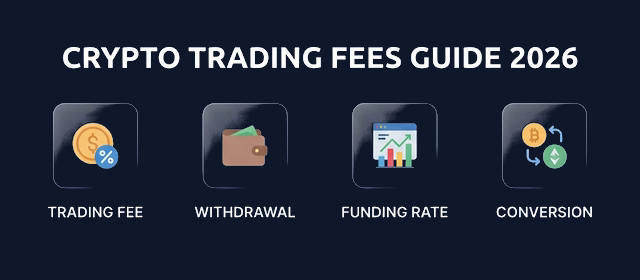
Quick Summary — Crypto Trading Fees in 30 Seconds
Every time you trade cryptocurrency, the exchange charges you a fee. These fees typically range from 0.01% to 0.20% per trade, but they add up fast — a trader with $50,000 monthly volume paying 0.10% loses $600/year in fees alone.
The good news: you can cut these costs by 20-60% using strategies like VIP tiers, native token discounts, limit orders, and cashback rebate programs. This guide breaks down every fee type and shows you exactly how to reduce them in 2026.
What Are Crypto Trading Fees?
Crypto trading fees are charges that exchanges collect every time you buy, sell, or convert digital assets. They are the primary revenue source for platforms like Binance, OKX, Bybit, MEXC, and Bitget. Understanding these fees is the first step to minimizing your trading costs and maximizing your returns.
When you place a trade on any exchange, the platform takes a small percentage of the transaction value. This percentage varies based on several factors: the exchange you use, your trading volume over 30 days, whether you use limit or market orders, and whether you hold the exchange's native token.
Key terms you need to know:
| Term | Definition | Typical Range |
|---|---|---|
| Trading fee | The main cost per trade | 0.02%-0.10% |
| Maker fee | Fee for limit orders that add liquidity to the order book | 0.00%-0.10% |
| Taker fee | Fee for market orders that remove liquidity from the order book | 0.02%-0.10% |
| Spread | The difference between the best buy (bid) and best sell (ask) price | 0.01%-0.50% |
| Slippage | Difference between expected and actual execution price | 0.00%-2.00% |
| Funding rate | Fee exchanged between long/short positions on perpetual contracts | -0.03% to +0.03% |
| Withdrawal fee | Fixed or variable fee for transferring crypto off the exchange | $1-$25+ |
Most beginners focus only on the listed trading fee, but the total cost of a trade also includes spread, slippage, and potential withdrawal fees. Understanding all of these is essential for optimizing your costs.
Why trading fees matter more than you think
Let's put this in perspective with real numbers:
| Monthly Volume | Fee Rate | Monthly Fees | Annual Fees | With 30% Cashback | Net Annual Fees |
|---|---|---|---|---|---|
| $5,000 | 0.10% | $5 | $60 | -$18 | $42 |
| $25,000 | 0.10% | $25 | $300 | -$90 | $210 |
| $50,000 | 0.08% | $40 | $480 | -$144 | $336 |
| $100,000 | 0.06% | $60 | $720 | -$216 | $504 |
| $500,000 | 0.04% | $200 | $2,400 | -$720 | $1,680 |
| $1,000,000 | 0.03% | $300 | $3,600 | -$1,080 | $2,520 |
| $5,000,000 | 0.02% | $1,000 | $12,000 | -$3,600 | $8,400 |
At $50,000/month volume, you pay $480/year in fees. With cashback, that drops to $336. At $1M/month, you save over $1,000/year through cashback alone.
Types of Crypto Exchange Fees
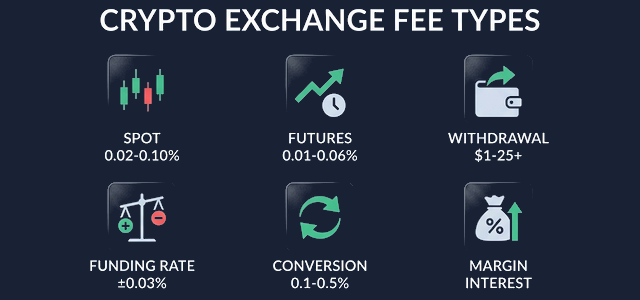
Exchanges charge multiple types of fees beyond just trading commissions. Here is a comprehensive breakdown of every fee you should know about:
| Fee Type | Typical Range | When Charged | Can You Reduce It? |
|---|---|---|---|
| Spot trading fee | 0.02%-0.10% | Every spot buy/sell | Yes — VIP, tokens, cashback |
| Futures trading fee | 0.01%-0.06% | Every futures trade | Yes — VIP, tokens, cashback |
| Withdrawal fee | $1-$25+ | When you withdraw to an external wallet | Choose cheaper networks (TRC-20, Arbitrum) |
| Deposit fee | Usually free | When you deposit crypto | Most exchanges offer free deposits |
| Funding rate | -0.03% to +0.03% | Every 8 hours on perpetual positions | Time your entries wisely |
| Conversion/swap fee | 0.10%-0.50% | Instant token swaps | Use spot trading instead |
| Margin interest | 0.01%-0.10%/day | Borrowing for margin trading | Minimize borrowing duration |
| Cross-margin liquidation | 0.50%-1.50% | Forced closure of positions | Maintain proper margin ratios |
Spot trading fees
Spot trading fees are the most straightforward — you pay a percentage of every trade you make. Most exchanges charge between 0.02% and 0.10% for spot trades, with maker fees typically lower than taker fees.
Key insight: On MEXC, spot maker fees are 0% — meaning you pay nothing when using limit orders. This makes MEXC extremely attractive for traders who primarily use limit orders.
Futures trading fees
Futures trading fees are generally lower than spot fees because exchanges earn additional revenue from funding rates and liquidation fees. However, because futures traders often use high leverage, the actual dollar amount paid in fees can be much higher.
Important: When trading futures with leverage, your fees are calculated on the notional value of the position, not your margin. A $1,000 position with 10x leverage has a $10,000 notional value, and fees are charged on that full $10,000.
Withdrawal fees
Withdrawal fees vary dramatically depending on the cryptocurrency and the network you choose:
| Crypto | Network | Typical Fee | Dollar Equivalent |
|---|---|---|---|
| BTC | Bitcoin | 0.0002-0.0005 BTC | $12-$30 |
| ETH | Ethereum | 0.001-0.005 ETH | $3-$15 |
| USDT | TRC-20 (Tron) | 1 USDT | $1 |
| USDT | ERC-20 (Ethereum) | 3-10 USDT | $3-$10 |
| USDT | Arbitrum | 0.1-1 USDT | $0.10-$1 |
| USDT | BSC (BNB Chain) | 0.3-1 USDT | $0.30-$1 |
Pro tip: Always use TRC-20 or Arbitrum for USDT transfers — you'll save $2-$9 per withdrawal compared to ERC-20.
Funding rates — the hidden cost of perpetual contracts
Funding rates are often overlooked but can significantly impact profitability for traders who hold perpetual futures positions. Every 8 hours, longs pay shorts (positive funding) or shorts pay longs (negative funding).
During bull market periods, funding rates can reach 0.1% or higher per 8-hour period — that's 0.3%/day or nearly 9%/month. A $10,000 position could cost you $900/month just in funding fees, regardless of whether your trade is profitable.
Maker vs Taker Fees Explained
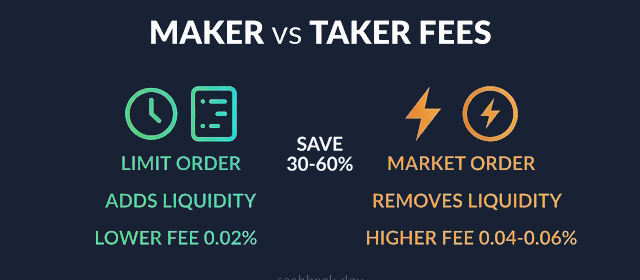
Understanding the difference between maker and taker fees is crucial for minimizing costs. This distinction exists on every major exchange and directly affects how much you pay per trade.
What is a maker?
A maker places an order that doesn't immediately execute. Instead, it "makes" liquidity by sitting in the order book, waiting for someone else to match it. Limit orders that aren't immediately fillable are maker orders.
Example: Bitcoin is trading at $65,000. You place a limit buy order at $64,800. This order goes into the order book and waits — you've "made" liquidity available for others.
What is a taker?
A taker places an order that executes immediately against existing orders in the book. Market orders are always taker orders. Limit orders that can be filled immediately are also taker orders.
Example: Bitcoin is at $65,000. You place a market buy order — it executes instantly at the best available price. You've "taken" liquidity from the book.
Why maker fees are lower
Exchanges want more liquidity in their order books because it attracts more traders and creates tighter spreads. To incentivize liquidity providers, exchanges charge lower fees (or even pay rebates) to makers, while charging higher fees to takers who remove liquidity.
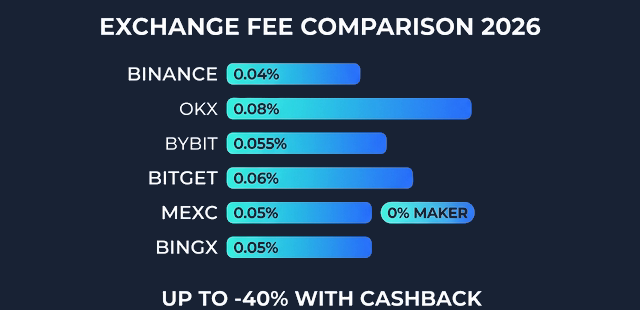
Maker vs taker fee comparison by exchange (2026):
| Exchange | Spot Maker | Spot Taker | Futures Maker | Futures Taker |
|---|---|---|---|---|
| Binance | 0.10% | 0.10% | 0.02% | 0.05% |
| Bybit | 0.10% | 0.10% | 0.02% | 0.055% |
| OKX | 0.08% | 0.10% | 0.02% | 0.05% |
| MEXC | 0.00% | 0.05% | 0.00% | 0.03% |
| Bitget | 0.10% | 0.10% | 0.02% | 0.06% |
| BingX | 0.10% | 0.10% | 0.02% | 0.05% |
| Gate.io | 0.15% | 0.15% | 0.015% | 0.05% |
MEXC stands out with 0% maker fees on both spot and futures — the lowest in the industry. OKX's spot maker fee of 0.08% is also notably lower than most competitors.
How to ensure you're always the maker
To consistently pay maker fees instead of taker fees:
Use limit orders exclusively — set a price below the current market for buys, above for sells
Avoid chasing the market price — patience saves money on every trade
Use "post-only" mode if available — this ensures your order is rejected rather than filled as a taker
For scalping, set limits 0.01-0.05% away from the current price to ensure maker status
A trader doing $100,000/month in volume who switches from market orders (0.10% fees) to limit orders (0.02% maker fees) saves $80/month or $960/year — before even considering cashback.
Complete Fee Comparison: Major Exchanges 2026
Here is the most comprehensive fee comparison across all major crypto exchanges, including default rates, VIP rates, and available discounts:
| Feature | Binance | Bybit | OKX | MEXC | Bitget | BingX | Gate.io |
|---|---|---|---|---|---|---|---|
| Spot Maker | 0.10% | 0.10% | 0.08% | 0.00% | 0.10% | 0.10% | 0.15% |
| Spot Taker | 0.10% | 0.10% | 0.10% | 0.05% | 0.10% | 0.10% | 0.15% |
| Futures Maker | 0.02% | 0.02% | 0.02% | 0.00% | 0.02% | 0.02% | 0.015% |
| Futures Taker | 0.05% | 0.055% | 0.05% | 0.03% | 0.06% | 0.05% | 0.05% |
| Token Discount | 25% (BNB) | None | None | None | None | None | 25% (GT) |
| VIP Tiers | 9 levels | 5 levels | 8 levels | 4 levels | 6 levels | 5 levels | 16 levels |
| Lowest VIP Maker | 0.012% | 0.005% | 0.015% | 0.00% | 0.01% | 0.02% | 0.00% |
| Lowest VIP Taker | 0.024% | 0.025% | 0.03% | 0.015% | 0.02% | 0.025% | 0.025% |
| Max Cashback | 20% | 30% | 25% | 32.5% | 30% | 25% | 20% |
| Cashback link | cashback.day | cashback.day | cashback.day | cashback.day | cashback.day | cashback.day | cashback.day |
Which exchange has the lowest fees overall?
For most traders, MEXC offers the lowest fees with 0% maker fees on both spot and futures. Combined with up to 32.5% cashback through cashback.day, MEXC is the cheapest exchange for cost-conscious traders.
For traders who need the deepest liquidity and most trading pairs, Binance combined with BNB discount (25%) and cashback (20%) provides competitive effective fees with superior execution.
7 Proven Ways to Reduce Your Trading Fees
1. Use cashback rebate programs
The single most effective way to reduce fees is through cashback programs that refund a portion of every trading fee you pay. Platforms like cashback.day return 10%-32.5% of your fees automatically.
- Savings: 10%-32.5% of all fees
- Effort: One-time signup (2 minutes)
- Works with: All other strategies simultaneously
- How to start: cashback.day/compare
2. Pay fees with native tokens
Some exchanges offer significant discounts when you pay trading fees with their native token:
| Exchange | Token | Discount | How to Activate |
|---|---|---|---|
| Binance | BNB | 25% | Settings → Use BNB for fees |
| Gate.io | GT | 25% | Settings → Pay with GT |
This is stackable with cashback — Binance users can get 25% BNB discount + 20% cashback = 40%+ total reduction.
3. Reach VIP tiers
All exchanges offer reduced fees for high-volume traders. The more you trade, the less you pay per trade:
| Exchange | VIP 1 Requirement | Maker Reduction | Taker Reduction |
|---|---|---|---|
| Binance | $1M/30d or 25 BNB | 10% off | 10% off |
| Bybit | $1M/30d | 25% off | 9% off |
| OKX | $5M/30d | 25% off | 20% off |
| MEXC | $5M/30d | 0% (already) | 33% off |
| Bitget | $5M/30d | 40% off | 20% off |
4. Use limit orders (maker orders)
By consistently using limit orders instead of market orders, you pay maker fees (which are 20-100% lower than taker fees). On MEXC, maker fees are literally 0%.
5. Consolidate volume on one exchange
Instead of splitting your trading across multiple exchanges, consolidating on one exchange helps you reach VIP tiers faster, unlocking lower fees on all your trades.
6. Choose the right trading pair
Fee rates can vary by trading pair. Major pairs (BTC/USDT, ETH/USDT) often have tighter spreads and lower effective costs than exotic pairs.
7. Time your funding rate payments
For perpetual futures traders: check funding rates before opening positions. When funding rates are abnormally high (>0.05%), consider waiting or using a different exchange with lower rates.
Does Cashback Actually Lower Your Trading Costs?
Yes — cashback programs genuinely reduce your net trading costs. Here's a detailed breakdown of how cashback works and exactly how much you save:
How cashback works:
You sign up for an exchange through cashback.day using a referral link
You trade normally — no changes to your strategy needed
The exchange pays a referral commission to the cashback platform
The platform returns most of that commission to you as cashback (10%-32.5%)
Cashback is paid daily in USDT directly to your exchange account
Real savings examples:
| Trader Profile | Monthly Volume | Exchange | Fee Rate | Monthly Fees | Cashback% | Monthly Savings | Annual Savings |
|---|---|---|---|---|---|---|---|
| Beginner spot | $5,000 | Binance | 0.10% | $5 | 20% | $1.00 | $12 |
| Active spot | $50,000 | OKX | 0.08% | $40 | 25% | $10.00 | $120 |
| Futures (5x) | $250,000 | Bybit | 0.05% | $125 | 30% | $37.50 | $450 |
| Futures (10x) | $1,000,000 | MEXC | 0.03% | $300 | 32.5% | $97.50 | $1,170 |
| Day trader | $5,000,000 | MEXC | 0.02% | $1,000 | 32.5% | $325.00 | $3,900 |
| Pro scalper | $20,000,000 | Bybit | 0.02% | $4,000 | 30% | $1,200.00 | $14,400 |
Why it's not "too good to be true"
Cashback is funded by referral commissions that exchanges pay to acquire new traders. Exchanges spend millions on marketing — referral commissions are a cost-effective alternative. The cashback platform keeps a small margin (typically 5-10%), and you receive the rest.
Your fees don't increase. The exchange charges exactly the same fees whether you signed up directly or through a cashback link. The only difference is that a portion of those fees gets returned to you.
Calculate your expected savings: cashback.day/calculator
The Optimal Fee Reduction Strategy for 2026
Combining all available strategies creates the maximum possible fee reduction. Here's the optimal setup for each major exchange:
Binance optimal strategy:
| Strategy Layer | Reduction | Effective Fee (from 0.10%) |
|---|---|---|
| Base fee | 0% | 0.100% |
| BNB discount (-25%) | 25% | 0.075% |
| cashback.day (-20%) | 15% | 0.060% |
| Limit orders (maker) | varies | 0.060% maker |
| VIP 1 (if qualified) | 10% | 0.054% |
| Total effective | ~46% | ~0.054% |
MEXC optimal strategy:
| Strategy Layer | Reduction | Effective Fee |
|---|---|---|
| Spot maker fee | — | 0.000% |
| Spot taker fee | — | 0.050% |
| cashback.day (-32.5%) | 32.5% | 0.034% taker |
| Limit orders (maker) | 100% | 0.000% maker |
| Total effective | 100% maker / 66% taker | 0.000% maker / 0.034% taker |
MEXC + maker orders + cashback = effectively free trading. This is the lowest cost available anywhere in crypto in 2026.
Hidden Fees Most Traders Miss
Beyond the obvious trading fees, several hidden costs can eat into your profits:
1. Spread cost
The bid-ask spread is an invisible cost on every trade. On liquid pairs like BTC/USDT, the spread is usually 0.01% or less. On illiquid altcoins, it can be 0.5-2% — far more than the trading fee itself.
2. Slippage on large orders
If you're trading more than $50,000 in a single order, slippage can cost you 0.05-0.50% on top of the trading fee. Solution: break large orders into smaller ones, or use TWAP (Time-Weighted Average Price) algorithms.
3. Funding rate compounding
Holding a leveraged perpetual position for days or weeks means funding rates compound. A seemingly small 0.01% per 8-hour period becomes 0.03%/day, 0.21%/week, or 0.90%/month — a significant drag on returns.
4. Conversion fees
Converting between tokens using the exchange's "Convert" feature typically charges 0.10-0.50% — much more than placing a spot trade (0.02-0.10%). Always use the spot order book for better rates.
5. Cross-margin liquidation penalties
If your position gets liquidated, exchanges charge liquidation fees of 0.50-1.50% on top of your losses. Proper risk management with stop-losses saves both your capital and avoids these penalty fees.
6. Network fee mispricing
Some exchanges charge withdrawal fees that are significantly higher than actual network costs. Always compare the exchange's fee with current on-chain gas prices to avoid overpaying.
Frequently Asked Questions
What are the cheapest crypto trading fees?
MEXC offers the lowest trading fees with 0% maker fees on both spot and futures. Combined with 32.5% cashback through cashback.day, MEXC provides the cheapest trading experience available. Binance is competitive when using BNB discount (25% off) plus cashback.
How much do crypto trading fees actually cost per year?
It depends on your volume. A trader with $10,000/month in volume at 0.10% fees pays about $120/year. At $100,000/month with 0.06% fees, it's $720/year. Active futures traders with $1M+/month can pay $3,600+/year — making fee reduction strategies essential.
Can I avoid crypto trading fees completely?
Almost. On MEXC, maker fees are 0% for both spot and futures — so if you use exclusively limit orders, you pay zero trading fees. Add cashback and you actually earn money back on taker orders too. However, you cannot fully avoid all costs (spread, slippage, withdrawal fees still apply).
What is the difference between maker and taker fees?
Maker fees are charged when you add liquidity to the order book (limit orders that don't immediately fill). Taker fees are charged when you remove liquidity (market orders or immediately-filled limit orders). Maker fees are always lower — sometimes 0% — because exchanges want to incentivize liquidity.
How does crypto cashback reduce my trading fees?
Cashback programs return 10%-32.5% of your trading fees after each trade. You sign up through a platform like cashback.day, trade normally, and receive daily USDT rebates. This is funded by the exchange's referral commission — your fees don't change, you just get money back.
Are crypto exchange fees negotiable?
For retail traders, fees are set by the exchange's tier structure. However, VIP tiers automatically reduce fees based on your 30-day volume. For institutional traders ($50M+/month), most exchanges offer customized fee agreements — contact their OTC/institutional desk for details.
What's the best strategy to minimize all crypto trading costs?
The optimal strategy combines multiple approaches: (1) Sign up through cashback.day for automatic cashback, (2) Pay with the exchange's native token if available, (3) Use limit orders for maker fees, (4) Consolidate volume for VIP tiers, (5) Choose cheap withdrawal networks like TRC-20, and (6) Avoid the "Convert" feature — use spot trading instead.
Sources: Official fee schedules from Binance, Bybit, OKX, MEXC, Bitget, BingX, Gate.io (Q1 2026). Cashback rates verified through cashback.day affiliate agreements. Withdrawal fees current as of March 2026 and subject to network conditions.