Quick Summary — What Is Crypto Trading Fee Cashback?
Crypto trading fee cashback is a program where you receive a portion of your trading fees back after every trade on a cryptocurrency exchange. Also called a commission rebate or fee refund, this mechanism returns between 10% and 32.5% of the fees you pay — automatically, in USDT or the exchange's native token.
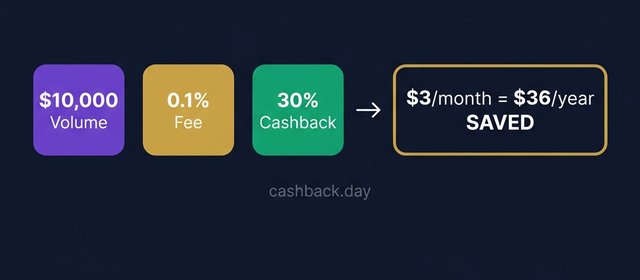
Key takeaway: If you trade $10,000/month and pay 0.1% in fees ($10), a 30% cashback returns $3 per month — or $36/year — with zero extra effort. For active traders doing $100,000+ monthly volume, that number grows to $180–$7,800+ per year — a significant amount that compounds over time.
What Is Crypto Trading Fee Cashback?
Crypto trading fee cashback is a financial incentive where a portion of the trading fees (also called commissions) charged by a cryptocurrency exchange is returned to the trader. This is different from signup bonuses or promotional airdrops — cashback is recurring and applies to every qualifying trade you make, for as long as you keep trading.
The concept is similar to credit card cashback programs you may already know: every time you make a purchase (or in this case, a trade), a small percentage comes back to you. The difference is that crypto cashback is funded by the exchange's referral program, not by the exchange itself directly.
How it works in simple terms:
You place a trade on an exchange (e.g., Binance, Bybit, OKX)
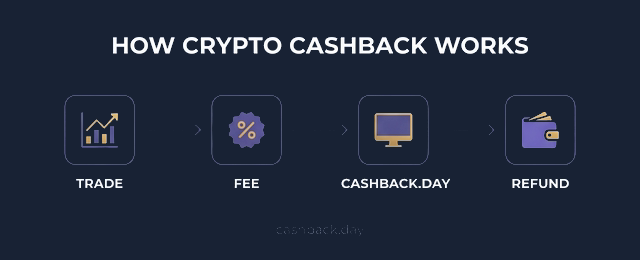
The exchange charges a trading fee (typically 0.02%–0.1%)
A cashback platform like cashback.day returns a percentage of that fee to you
The rebate is paid in USDT, BTC, or the exchange's token — usually within 24 hours
This process is completely automatic. Once you sign up through a cashback referral link, every trade you make generates a rebate. There is no minimum volume requirement, no lock-up period, and no hidden conditions.
Key terms defined:
| Term | Definition |
|---|---|
| Cashback | A refund of part of your trading fee, paid after each trade |
| Trading fee | The commission an exchange charges per trade (maker/taker fee) |
| Maker fee | Fee charged when you add liquidity to the order book (limit orders) |
| Taker fee | Fee charged when you remove liquidity from the order book (market orders) |
| Rebate | Another word for cashback — a partial refund of fees paid |
| Commission refund | The mechanism by which exchanges return fees via referral/affiliate systems |
| USDT | Tether stablecoin, the most common currency for cashback payments |
| Native token | Exchange-specific token (BNB for Binance, BIT for Bybit) sometimes used for cashback |
In summary: Crypto cashback = you trade, the exchange charges fees, and a cashback platform refunds a portion back to you. It functions like a loyalty reward that works on every single trade, indefinitely.
How Does Crypto Trading Cashback Work?
Crypto cashback programs work through referral and affiliate partnerships between cashback platforms and exchanges. Here is the detailed flow of how money moves through the system:
Step-by-step process:
Sign up through a cashback platform (like cashback.day) using a special referral link
Your account is linked to the platform's affiliate partnership with the exchange
Trade normally — spot, futures, perpetual contracts, or margin trading
The exchange pays a referral commission to the cashback platform for bringing your trading volume
The platform shares most of that commission back to you as cashback
Where does the money come from?
This is the most common question traders ask, and the answer is straightforward: the cashback does not come from your own funds. Exchanges have built-in referral programs that pay commissions to affiliates who bring in trading volume. These commissions typically range from 20% to 50% of the trading fees collected from referred users.
Cashback platforms like cashback.day pass the majority of that commission to you instead of keeping it all. For example, if an exchange pays 40% of your trading fees as a referral commission, and the cashback platform keeps 10% as their operating margin, you receive 30% of your fees back. This is a win-win-win arrangement:
- You save money on every trade
- The exchange gets a new active trader
- The cashback platform earns a sustainable margin
Why do exchanges pay referral commissions?
Customer acquisition in the crypto industry is extremely competitive. Exchanges spend millions on marketing, sponsorships, and promotions. Paying referral commissions is actually one of the most cost-effective ways for exchanges to acquire new traders because they only pay when the user actually trades — there is no wasted spend on users who sign up but never trade.
This is why cashback programs are not "too good to be true." They are a fundamentally sound business model backed by real revenue sharing.
Cashback rates by exchange (2026):
| Exchange | Spot Cashback | Futures Cashback | Payment Method | Payment Frequency |
|---|---|---|---|---|
| Binance | Up to 20% | Up to 20% | USDT | Daily |
| Bybit | Up to 30% | Up to 30% | USDT | Daily |
| OKX | Up to 25% | Up to 25% | USDT | Daily |
| MEXC | Up to 32.5% | Up to 32.5% | USDT | Daily |
| Bitget | Up to 30% | Up to 30% | USDT | Daily |
| BingX | Up to 25% | Up to 25% | USDT | Daily |
| Gate.io | Up to 20% | Up to 20% | USDT | Weekly |
In summary: Cashback comes from the exchange's own referral commission — not from your funds. Platforms like cashback.day maximize what gets returned to you by keeping only a small operating margin.
Is Crypto Cashback the Same as Rebate?
Yes — crypto cashback and rebate are essentially the same thing. Both refer to receiving a portion of your trading fees back. The terminology varies by region and platform:
| Term | Common usage |
|---|---|
| Cashback | Most common in consumer-facing platforms |
| Rebate | Often used in professional/institutional trading |
| Commission refund | Technical term used by exchanges |
| Fee kickback | Informal term, same concept |
| Trading reward | Marketing term some exchanges use |
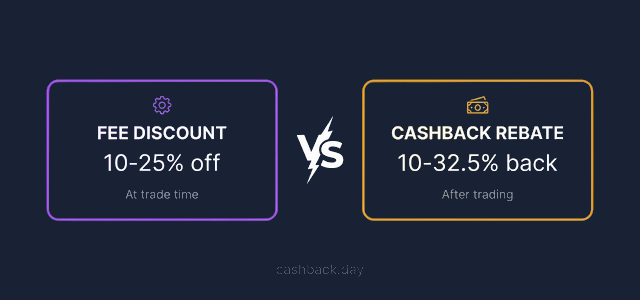
Important distinction: A fee discount and a cashback/rebate are different mechanisms that can be stacked together:
| Feature | Fee Discount | Cashback/Rebate |
|---|---|---|
| When applied | Before the trade | After the trade |
| How it works | Reduces fee rate (e.g., 25% off with BNB) | Returns a % of fees paid |
| Examples | BNB discount on Binance, VIP tiers | cashback.day referral programs |
| Can be stacked? | Yes, with cashback | Yes, with fee discounts |
This is a critical point many traders miss: you can use fee discounts AND cashback simultaneously. For example, on Binance you can pay fees with BNB (25% discount), AND receive 20% cashback through cashback.day. Your effective fee reduction is roughly 40% — much more than either program alone.
In summary: Cashback = rebate = commission refund. They all mean you get money back after trading. Fee discounts are different — they reduce fees upfront. Use both together for maximum savings.
Who Is Eligible for Crypto Cashback?
Almost every crypto trader can receive cashback, but there are specific requirements depending on the program:
Eligibility requirements:
- New accounts created through a cashback platform's referral link
- Traders on supported exchanges (Binance, Bybit, OKX, MEXC, Bitget, BingX, Gate.io, and more)
- Both spot and futures trading qualify
- Works for all trading volumes — from $100/month to millions
- No minimum trading period or lock-up
- Already trading? You can create a new account using a family member's information through our referral link on cashback.day to start earning cashback
Who benefits the most?
| Trader type | Monthly volume | Fee rate | Cashback rate | Est. monthly savings | Annual savings |
|---|---|---|---|---|---|
| Beginner | $1,000 | 0.10% | 20% | $0.20 | $2.40 |
| Casual | $5,000 | 0.10% | 20% | $1.00 | $12.00 |
| Active trader | $50,000 | 0.06% | 25% | $7.50 | $90.00 |
| Day trader | $500,000 | 0.04% | 30% | $60.00 | $720.00 |
| Scalper | $2,000,000 | 0.03% | 30% | $180.00 | $2,160.00 |
| High-volume/pro | $5,000,000+ | 0.02% | 32.5% | $325.00+ | $3,900.00+ |
| Institutional | $50,000,000+ | 0.01% | 32.5% | $1,625.00+ | $19,500.00+ |
The pattern is clear: cashback matters more the more you trade. But even a casual trader saving $12/year is getting free money — there is no reason not to have cashback active on your account.
In summary: Anyone with a new account on a supported exchange is eligible. The more you trade, the more you save — high-volume traders can save thousands per month.
How Much Can You Save with Crypto Cashback?
Savings depend on three factors: trading volume, fee rate, and cashback percentage. Let us break down each factor and show you exactly how to calculate your expected savings.
Savings calculation formula:
Monthly savings = Monthly volume x Fee rate x Cashback %
Factor 1: Trading Volume
Your trading volume is the total dollar value of all trades you execute in a month. This includes both buy and sell sides. If you buy $10,000 of Bitcoin and then sell it, your total volume is $20,000.
Important note for futures traders: Futures volume is calculated on the notional value. If you trade with 10x leverage, a $1,000 position has $10,000 notional volume. This means futures traders often generate much higher volumes — and therefore much higher cashback amounts — than spot traders.
Factor 2: Fee Rate
Fee rates vary by exchange, trading pair, and your VIP tier. Here is a realistic breakdown:
| Exchange | Default Maker | Default Taker | VIP Maker | VIP Taker |
|---|---|---|---|---|
| Binance | 0.10% | 0.10% | 0.02% | 0.04% |
| Bybit | 0.10% | 0.10% | 0.01% | 0.03% |
| OKX | 0.08% | 0.10% | 0.02% | 0.05% |
| MEXC | 0.00% | 0.05% | 0.00% | 0.03% |
| Bitget | 0.10% | 0.10% | 0.02% | 0.04% |
Pro tip: Use limit orders whenever possible. Maker fees are always lower than taker fees, and on some exchanges (like MEXC), maker fees are 0%. Even with zero maker fees, taker fees still generate cashback when you use market orders.
Factor 3: Cashback Percentage
Cashback percentages depend on the platform and exchange. They typically range from 10% to 32.5%. Higher cashback rates are available on exchanges with more competitive affiliate programs.
Detailed example calculations:
| Scenario | Volume/month | Fee rate | Fees paid | Cashback % | Monthly savings | Annual savings |
|---|---|---|---|---|---|---|
| Casual spot trader | $5,000 | 0.10% | $5.00 | 20% | $1.00 | $12.00 |
| Active spot trader | $50,000 | 0.08% | $40.00 | 25% | $10.00 | $120.00 |
| Futures trader (5x) | $200,000 | 0.05% | $100.00 | 30% | $30.00 | $360.00 |
| Active futures (10x) | $1,000,000 | 0.04% | $400.00 | 30% | $120.00 | $1,440.00 |
| Day trader (20x) | $5,000,000 | 0.03% | $1,500.00 | 32.5% | $487.50 | $5,850.00 |
| Pro scalper | $20,000,000 | 0.02% | $4,000.00 | 32.5% | $1,300.00 | $15,600.00 |
Ways to maximize your cashback:
Choose exchanges with higher cashback rates — MEXC offers up to 32.5% through cashback.day
Use fee discounts alongside cashback (e.g., BNB on Binance gives 25% fee discount + 20% cashback)
Consolidate trading on one exchange to unlock VIP fee tiers faster
Trade futures — leverage amplifies your notional volume, generating more cashback per dollar of capital
Use limit orders — although maker fees are lower, every fee generates cashback
Compare rates using cashback.day's comparison tool before choosing your exchange
Calculate your expected savings using the cashback calculator to see exact numbers for your volume
In summary: Even casual traders save $12+/year. Active futures traders save $360–$1,440/year. Professional traders can save $5,850–$15,600+/year — substantial amounts that directly improve your trading P&L.
Types of Crypto Cashback Programs
Not all cashback programs are the same. Understanding the differences helps you choose the best option for your trading style.
1. Referral-based cashback (most common, best for most traders)
This is the most widely available type and typically offers the highest rates. You sign up for an exchange through a referral link provided by a cashback platform.
- How it works: Sign up through a referral link, earn cashback on every trade for the lifetime of your account
- Rates: 10%–32.5% of trading fees
- Duration: Lifetime — as long as you keep trading
- Pros: Highest rates, no effort required, works immediately
- Cons: Must sign up through the specific link (existing accounts may not qualify)
- Best example: Programs available on cashback.day
2. Exchange-native programs
Some exchanges have built-in loyalty or cashback programs as part of their platform.
- How it works: Hold exchange tokens, reach VIP tiers, or participate in exchange promotions
- Rates: Usually lower than third-party platforms (5%–15%)
- Duration: Varies — often requires maintaining certain conditions
- Pros: No third-party dependency
- Cons: Lower rates, may require token holding (price risk), complicated tier systems
- Examples: Binance VIP program, Bybit loyalty rewards
3. Time-limited promotions
Exchanges occasionally offer promotional cashback campaigns with higher-than-normal rates.
- How it works: Trade during a specific period to earn bonus cashback
- Rates: Can be very high (50%+) but temporary
- Duration: Usually 1–4 weeks
- Pros: Very high rates during the promotion
- Cons: Not sustainable, often has minimum volume requirements
- Examples: New listing promotions, holiday campaigns, trading competitions
4. Tiered/VIP cashback
Some platforms offer escalating cashback rates based on your cumulative trading volume.
- How it works: Trade more volume to unlock higher cashback tiers
- Rates: Start at 10%–15%, scale up to 30%+ at highest tiers
- Duration: Ongoing, but tier status may reset monthly
- Pros: Rewards loyalty and high volume
- Cons: Requires significant volume to reach top tiers
- Best for: Professional and institutional traders
Comparison of program types:
| Feature | Referral-based | Exchange-native | Time-limited | Tiered/VIP |
|---|---|---|---|---|
| Typical rate | 10%–32.5% | 5%–15% | 20%–50% | 10%–30% |
| Duration | Lifetime | Conditional | 1–4 weeks | Ongoing |
| Complexity | Very simple | Moderate | Simple | Complex |
| Best for | All traders | Token holders | Opportunists | High volume |
In summary: Referral-based cashback through platforms like cashback.day offers the best long-term value — lifetime cashback on every trade with the highest rates and zero complexity.
Crypto Cashback vs Other Fee Reduction Methods
Many traders use various methods to reduce their trading costs. Here is how cashback compares to other common approaches:
| Method | How it works | Savings | Stackable with cashback? |
|---|---|---|---|
| Cashback/rebate | Refund after trade | 10%–32.5% of fees | N/A |
| BNB/exchange token discount | Pay fees with native token | 25% of fees | Yes |
| VIP tier reductions | Lower fee rates with volume | 20%–80% of fees | Yes |
| Maker-only strategy | Use limit orders only | 50%+ lower fee rate | Yes |
| Fee-free promotions | Zero fees for limited time | 100% (temporary) | N/A |
The optimal strategy is to stack multiple methods. Here is an example for a Binance trader:
Pay fees with BNB: 25% discount on base fee
Reach VIP 1 tier: Lower taker fee from 0.10% to 0.09%
Use cashback.day: 20% cashback on remaining fees
Use limit orders: Pay maker fee (0.08% at VIP 1) instead of taker
Combined effect: Your effective fee can drop from 0.10% to approximately 0.048% — a 52% total reduction.
How to Get Started with Crypto Cashback
Getting cashback on your crypto trades takes less than 5 minutes. Here is the complete step-by-step guide:
Step 1: Choose your exchange
Visit cashback.day to compare cashback rates across Binance, Bybit, OKX, MEXC, Bitget, and more. Consider factors like:
- Cashback rate (higher is better)
- Exchange liquidity (important for large orders)
- Available trading pairs
- Fee structure (maker vs taker)
- Security and regulatory compliance
Step 2: Sign up through the cashback link
Click the referral link for your chosen exchange on cashback.day. This links your account to the cashback program. Important: you must sign up through this link for cashback to be activated. If you sign up directly on the exchange website, you will miss the cashback.
Step 3: Complete verification (KYC)
Most exchanges require identity verification. This is standard regulatory practice and ensures security. You will typically need:
- Government-issued ID (passport or national ID)
- Proof of address (utility bill or bank statement)
- Selfie for facial verification
Verification usually takes 5–30 minutes and is a one-time process.
Step 4: Deposit funds and start trading
Deposit crypto or fiat to your new account and trade as you normally would — spot, futures, margin, or any other supported product. There is no special trading interface or requirement.
Step 5: Receive your cashback
Rebates are typically calculated and paid daily in USDT. Most platforms allow you to track your cashback earnings in real-time through a dashboard or notification system.
Step 6: Withdraw or reinvest
Your cashback is credited to your exchange account like any other balance. You can withdraw it, reinvest it, or use it to fund more trades — earning even more cashback.
In summary: Visit cashback.day, pick an exchange, sign up through the referral link, trade normally, and receive automatic cashback. It takes 5 minutes to set up and saves money on every trade forever.
Common Misconceptions About Crypto Cashback
Let us address some common concerns and myths about crypto cashback programs:
"It sounds too good to be true"
It is not. Cashback is funded by real referral commissions that exchanges pay to attract new traders. This is a standard business model in the financial industry, similar to how credit card companies offer cashback funded by merchant fees.
"My existing account should get cashback too"
Unfortunately, cashback is linked to new accounts created through referral links. This is because the exchange only pays referral commissions for new users they acquire through the affiliate channel. However, you can create a new account using a family member's information through cashback.day to start receiving cashback immediately.
"High-frequency trading generates thousands in cashback — that can't be sustainable"
It is sustainable because the exchange collects 100% of your trading fees first. Cashback only returns 10%–32.5% of that. The exchange still profits from the remaining 67.5%–90% of your fees. In fact, exchanges actively want high-volume traders because they provide liquidity and generate significant fee revenue.
"Cashback rates will decrease over time"
While this is possible, most major platforms have maintained consistent rates for years. The competitive nature of the crypto exchange market means exchanges compete aggressively for trading volume, which keeps referral commissions — and therefore cashback rates — stable or even increasing.
"I'll pay more in fees to chase cashback"
This is a valid concern, but the solution is simple: do not change your trading behavior just to earn cashback. Cashback is designed to reduce the cost of trading you are already doing. If you trade $100,000/month regardless, adding cashback simply reduces your costs — there is no reason to trade more.
Frequently Asked Questions
What is crypto trading fee cashback?
Crypto trading fee cashback is a program where a percentage of the trading fees you pay on a cryptocurrency exchange is refunded to you. Rates typically range from 10% to 32.5% of your fees, paid automatically in USDT after each trade. The cashback comes from the exchange's referral commission, not from your own funds.
How does crypto cashback work?
When you sign up for an exchange through a cashback platform like cashback.day, the exchange pays a referral commission. The platform passes most of that commission back to you as cashback on every trade. The process is fully automatic — you trade normally, and cashback is credited to your account daily.
Is crypto cashback the same as rebate?
Yes. Cashback, rebate, and commission refund all refer to the same thing — receiving a portion of your trading fees back after trading. Fee discounts are different — they reduce your fees before the trade. You can stack both cashback and fee discounts for maximum savings.
Who is eligible for crypto cashback?
Any trader who creates a new account on a supported exchange through a cashback referral link is eligible. Both spot and futures trading qualify. There is no minimum volume requirement. If you already have an account, you can create a new one using a family member's information through cashback.day.
How much can you save with crypto cashback?
Savings depend on your trading volume and cashback rate. Casual traders save $12+/year. Active traders save $120–$360/year. Day traders save $720–$5,850/year. Professional traders can save $15,600+/year. Use the cashback calculator for exact numbers based on your volume.
Is there a minimum trading volume for cashback?
No. Cashback applies to every trade regardless of size. Whether you trade $10 or $10,000,000, you receive the same percentage back. There is no minimum volume, no lock-up period, and no hidden conditions.
Which exchanges support cashback?
Major exchanges including Binance, Bybit, OKX, MEXC, Bitget, BingX, Gate.io, and others support cashback through platforms like cashback.day. Visit cashback.day/compare for the complete list and current rates.